
Like a Ribbon Tied Around the Finger to Not Forget, or Like Picking at Scabs to Keep the Wound Open: A Conversation with Anna Zemlianski
The work of Anna Zemlianski is contemporary in several ways. On the one hand, it articulates an artistic approach to deal with the loss of belonging, Russia’s war on Ukraine, and related topics by delving into cinema’s past to find out what it holds for the present and the future. On the other hand, she brings into conversation two realms that have often been connected in the discourses and practices of archival and found footage-based films: in her work, the digital and the analog are radically entwined, creating a unique aesthetic and an experience where control and chance go hand in hand.
The fact that one might not have stumbled over her complex and yet somehow playful work might have a number of reasons, one being her unconditionally political understanding of moving image practices, which lead Zemlianski to share her films differently from the classical means of exhibition and festival screenings.
In the following, we are going to speak about Red Thread (2020)—a series of GIF-animations—and the three films The Stolen Moon (2003), ölmondnacht (OilMoonNight, 2022), and We Go Past Future (2024).
Alejandro Bachmann: All of these films consist of found footage that you extracted from Russian and Soviet cinema, films that were made up until the death of Josef Stalin in 1953, as well as Soviet and post-Soviet films by Yevgeni Yufit. Before we go in-depth with the specific approach and form of your moving image projects, I would like to understand where your interest for this cinema started and how precisely you would describe the nature of that interest.
Anna Zemlianski: My real interest in film history started twenty years ago, when I bought Amos Vogel’s Film as a Subversive Art. At that time, I could only read about most of the films that are included in the book*, but Vogel’s descriptions were intriguing. A number of the films were from the Soviet Union era, which resonated with me as I was born in the Ukrainian SSR in 1984. In 1991, shortly before the final collapse of the Soviet Union, my parents and I migrated to Germany. This made for a confusing child- and teenhood, as I was thrown into the tension between assimilating to Germany as fast as possible but also keeping the native language and certain traditions alive. For a long time this made me reject anything that had to do with that former life. It was through Tarkovski then, that I began to get curious again about what I was rejecting and his films made me want to see more Soviet cinema.

I have never visited my birth town or Ukraine again since we moved to Germany, and when I finally began making plans to visit in 2020 or 2021, those plans were halted first by the pandemic and then in 2022 by Russia’s war. This intensified my wish to learn more about life in the Soviet Union and to understand how my romantic view of communism fit the experiences of my family. So the nature of my interest is rooted in a personal connection, which makes me wonder how that life was depicted in a highly state-regulated cinema. But it’s also fuelled by an interest in film history and theory and the wish to engage with it intensely in all its forms, no matter if high or low art.
* I hope it’s okay to add a little side note that might not have so much to do with the actual topic, but I have been thinking about films as text, especially since I watched Reading // Binging // Benning by Kevin B. Lee (2017). I spent many years mostly reading about older/interesting/obscure films and not being able to see them because they were not easily available. This has changed, and nowadays almost anything can be found with a little bit of effort, which has been important for my own works (most of my art and film history education was made possible by Internet and file sharing; without it, I wouldn’t have had the chance to learn so much and to get admission to higher education); but I think there’s something interesting in only reading about a film and never actually seeing it.
A.B.: Before we talk specifically about your works which bring into play the personal and aesthetic dimensions you described, how would you describe the availability of films from the pre-revolutionary age and films from the Soviet Union era? Was your interest in this kind of cinema personal in the beginning and became an artistic practice afterwards or were you aware that watching these works was a means to an end, namely your own works?
A.Z.: I have a hard time just reading or watching something, so I collect quotes or make annotations when reading, and for many years now I’ve kept a film diary on Tumblr with stills and GIFs I make from most of the films I watch. It’s an opportunity for me to engage with the films in a different way, to have a moment to think about them again, to notice details I didn’t see in the initial watch, etc. It was the combination of me beginning to explore ways of animating with prints and paper in my personal art and this engagement with films that at some point made me really want to play with scenes from films.
The first result of this was E (2018), a short I made when I was doing my BA in and philosophy, which led to my BA thesis about GIFs as art and the series cinewomen (2018).
So when I began to engage more deeply with pre-Soviet and then Soviet cinema, this engagement joined an already developed habit, which gave me reason to not just watch and forget, but to think about them through my hands as well. It is compelling for me to use images from this period because on the one hand there is this personal connection that is not totally obvious, and it’s also something that gives me an opportunity to learn many adjacent things, which elevates it for me personally to something that is more than an aesthetic exercise or an animation experiment.
Currently, the availability of these films is great in general. Not many pre-Soviet films survived—just something over a hundred as far as I know—but most of them are available online either on YouTube or on official film archive sites, like Odesa Film Studio.
A.B.: Your mention of stills and especially GIFs lead us directly to some of your works, namely the Red Thread series. Each of these series has been assigned a year, ranging from 1908 to 1914. Each of them shows—in a loop, as GIFs do—one shot of black-and-white landscapes and a figure moving through them. But the figures are not visible, they seem to be cut or torn out of the picture, and something becomes visible beneath them: another image. Also, there is a red line moving through the landscapes, sometimes following the walking path of a person, sometimes preceding them, sometimes following the outline of a house in the picture. We also see fragments of texts, such as “I cry when I think of you and our beloved land with its fragrant gardens” or “Some strange force drags me to these sad banks.”
GIFs often are made up from existing materials, so in a way they could be understood as a continuation of a found footage practice into another digital media realm. Looking at the Red Thread series made me realize how I am always drawn to this minimal loop structure when looking at GIFs, and how, in the case of your work, the images I see become more complex, rich, and mysterious with every loop.
A.Z.: Yes, as you mention that GIFs are often already made up from existing materials, I am again reminded that GIFs are generally thought of as reactions and not as a specific kind of file format.
But the logic of the GIF is interesting in itself, as it exists between a photo or still image and a video that progresses in time. There’s also its mandatory silence and the autonomous loop that doesn’t need an audience to press play.
And yet, by now, it’s also an obsolete format, as most social media sites are either simulating it through videos or just use videos in the first place. In that sense, there’s a parallel between Eadweard Muybridge’s loops as an outlier in moving image history and the GIF as an outlier in the development of digital image formats.
For me, the phrase of “with every loop” is what I find especially intriguing. Even though a GIF has a certain duration that is tied to the number of frames and the amount of time each frame is visible, it also has no duration or a duration that could last forever, theoretically. So this autonomy of the GIF, like a still image, gives you all the time you want to take in what is presented. But on the other hand, what is presented can rarely be taken in completely, as it is always on the move, always fleeing. For the viewer this can be hypnotic and compelling, but also frustrating and tiring, and both types of sensations can often be experienced in the same viewing.
there’s a parallel between Eadweard Muybridge’s loops as an outlier in moving image history and the GIF as an outlier in the development of digital image formats
In Death ad Infinitum, Towards an Ontology of the GIF Tom McGinn describes this as “the felt dimension of the GIF.” The “relentless re-presentation of the same sequence embeds itself on the retina, becoming heavy”.1
As my idea for the Red Thread series evolved from not being able to travel and visit Ukraine, I initially thought of it as moving postcards: the depicted landscapes pointing to something real, capturing an actual place, even if it’s unclear where exactly it is; the red lines like absentminded scribbles, and the torn-out bodies pointing from the now to what’s coming (literally, as the images “beneath” the foreground image of one GIF are the foreground images of the next GIF).
Red Thread was supposed to go from 1908 to 1918, but I got stuck midway and picked up this idea of interweaving time, bodies and places again in my degree film, We Go Past Future (2024).
A.B.: Before we move to your next work, The Stolen Moon, which makes use of another technology closely related to digital culture, I would also like to understand your position on the places where your works become visible. The GIF is something that seems to lead us into the digital space, computer screens, and social media, all of them being structured by specific conditions of encountering and reflecting images. Yet, the other three works mentioned above seem to relate more clearly to the cinema space. How much is this thinking about visibility part of your artistic process?
A.Z.: Considering that my art practice is closely tied with a creative usage of platforms like Flickr and Tumblr, these kinds of spaces shape the way I think about art distribution considerably.
As uploading images, GIFs, and later videos became very easy and free, and my art practice evolved in this direction too, I knew that in the end I could share the work with someone.
These spaces were also my art school for many years. Not only learning from looking at and reading about the art of the other people on these platforms, but also the visibility of my own output and the reactions to it, gave me incentive to carry on and to develop my interests and approaches. Through Flickr I was able to learn about different techniques, and Tumblr fed my eye with a lot of art from all eras and all levels of importance and professionalism.
These spaces helped me gain access to undergird this knowledge with more traditional or canonical views, and surely this shaped my approach to creation and distribution in the sense that I’d still rather work with zero budget and put it out freely on the Internet.
So, while I think that my short films maybe relate to the cinema space because of their form, this is not the space I actually have in mind. I am happy to have my works screened somewhere, but most of the time I can’t even be present at these occasions and have to estimate how they look or sound in a space other than on the monitor in my home.
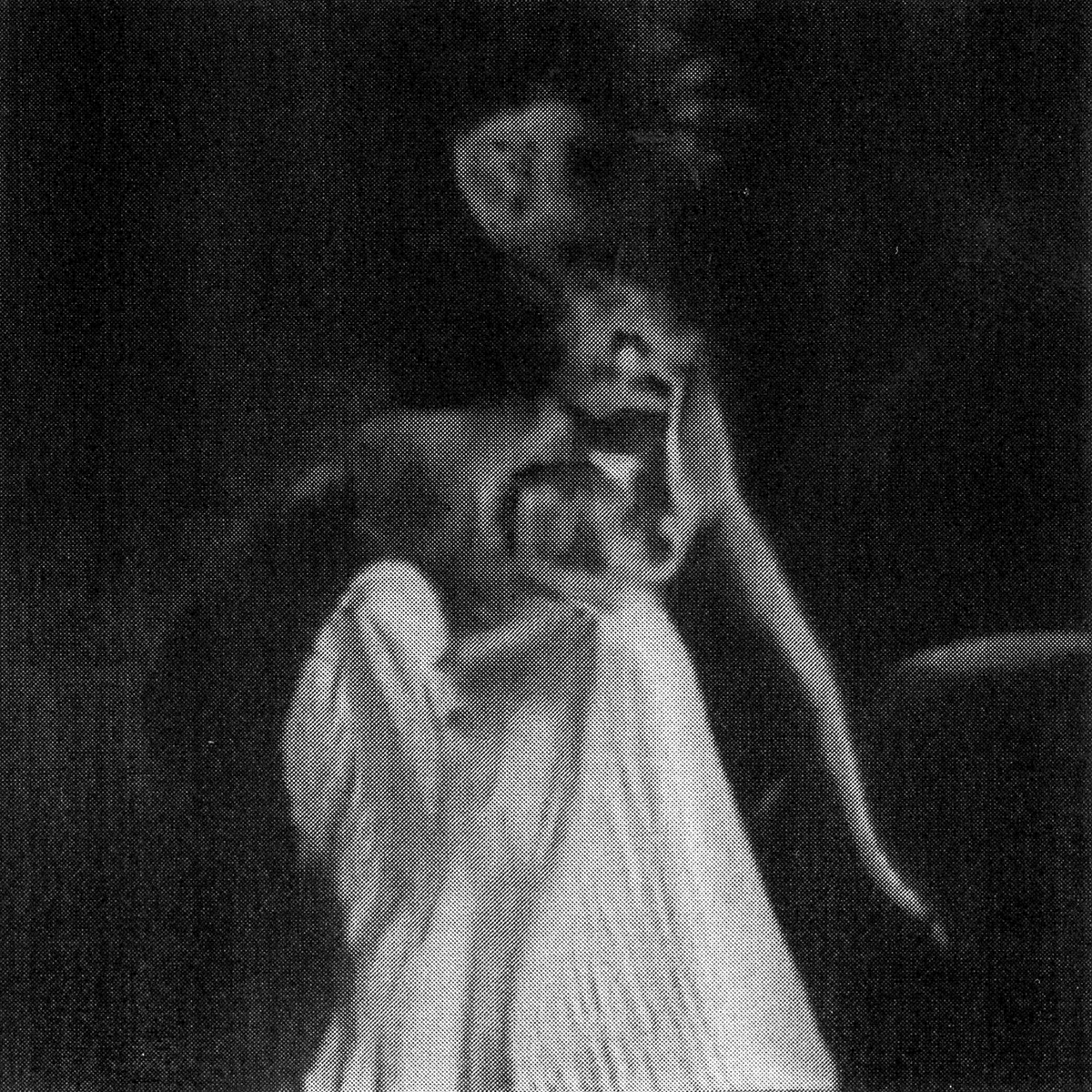
A.B.: It’s interesting to understand how you articulate an artistic practice—from the research of materials to the actual composition of the work to the question of distribution—that seems to exist in an in-between space, bringing into contact digital and network-based forms of image-practice with classical cinematic ones. This corresponds to a feeling I have when looking at The Stolen Moon, which you made with the help of digital image-making tools that were fed with images from films made in the pre-Soviet age. When watching these works I am also in a floating space of a constant in-between: I see letters and words that resemble Cyrillic writing but at the same time seem to lack something that makes them readable. I see landscapes and the outline of a person, but never long enough to be sure of what I see because everything seems to be in constant transformation of one into the other…
A.Z.: The footage of The Stolen Moon was achieved through machine learning. I fed a GAN (Generative Adversarial Network) with still images taken from all the pre-Soviet era films I could find, from the years 1908 to 1918. There are not many left, but most of these films are available online. The quality of the files I used was generally quite bad, not to mention the quality of the digitized films themselves, so the images that I could generate through StyleGAN are equally poor quality in a sense.
When working with GAN, one usually aspires to train it so well that it is able to infinitely generate very realistic images which are entirely artificial, as demonstrated by the AI random face generator, www.thispersondoesnotexist.com.
What I was interested in was to see what an ultimate pre-Soviet film would look like with this method. How much could the machine learn from what remains from that era and how would that be expressed visually? I find it very endearing that the results remind me of the two Monkeyshines films from 1889/1890, where the person in front of the camera is just a brightly shining ghostly shape moving around in a dark space whipped by decayed and damaged film material.
What I found an interesting experience while looking through the generated outputs was that I often had a sensation as if I could almost recognize a scene or person from a particular film. The data sets with which I trained the models were quite small, usually just a couple thousand film stills, often less, so my guess is that some actors or films just outweighed others by screen time and resembled their respective training images more than others. Or it was all my imagination.
My aim with The Stolen Moon was also to capture a bit of the mood of this particular place and era of cinema. For a long time, the Soviet avant-garde seemed to be a stroke of genius without precedence. But the Soviet film industry was a continuation of what was built before that. Directors like Yevgeni Bauer and Yakov Protazanov were already making innovative films, and production infrastructure had been successfully established before the Russian Revolution. But the bourgeois topics of dysfunctional families, decadence, lust, and death had to be obliterated. The psychological and existential dread and turmoil in these pre-Soviet films is astonishing, something that I hoped to capture by the text featured in my own film through the subtitles. For the text, I combined various intertitles from the films that make up the dataset, in the spirit of found poetry. The subtitles are burned-in and yellow, which again brings me back to file sharing, as they are an homage to digitized files of poor-quality recordings of foreign-language movies that often featured yellow burned-in subtitles. Sometimes it was difficult to tell if those subtitles actually corresponded to what was spoken, and in The Stolen Moon too, it is difficult to tell if there is a connection between the subs and what appear to be intertitles.
In the summer of 2022, while I was working on this film, the text-to-image generator MidJourney was released, which I was very curious to try. With an early version of MidJourney I made The Stolen Moon, the text-to-image version of The Stolen Moon. With text-to-image generators you use more or less descriptive text and style cues as prompts to generate images. So I used the text that I had collaged for The Stolen Moon and specific key words for prompting and generating images with a silent cinema aesthetic. The images are already figurative, but there is still a lot of idiosyncrasy to be found. Though both ways of image making—GAN and text-to-image—are fully digital and computer generated, for me they feel intensely organic and visceral with their never-fully-realized or impossibly twisted bodies. Like chewed pulp that will never regain its original form, their visual appearance corresponds to how they were made.
A.B.: Nevertheless, while GAN and text-to-image translation are purely digital tools, your work entails a very analog method of creating or transforming images. We have talked about this in relation to the Red Thread series.
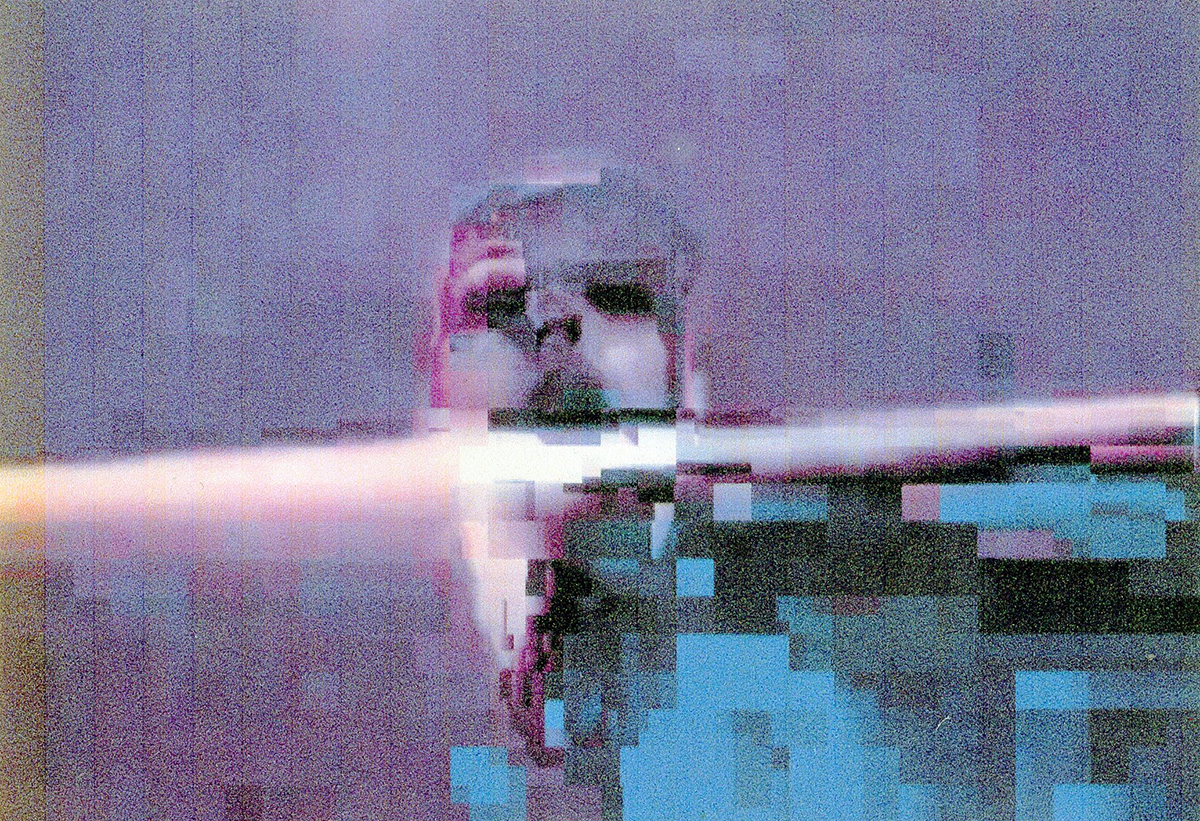
In ölmondnacht, the images are borrowed from films made after the end of the Soviet Union, and media-data manipulation processes such as datamoshing and glitch are combined with analog printing, the tearing of paper, and collage techniques. You said that The Stolen Moon was an endeavor to create an extract of pre-Soviet cinema. Is a similar idea the origin of ölmondnacht?
A.Z.: Opposed to the other short films we’re discussing, ölmondnacht turned out a very emotional film.
I was rewatching some of Yevgeni Yufit’s films at the beginning of 2022. By then, I was in the last phase of revisiting the pre-Soviet silent films for The Stolen Moon, which happened to be a lot of WWI and anti-German propaganda. Yufit’s films, especially the early shorts, are a parody of Soviet silent cinema. Maybe this is what inspired my rewatching. When Russia invaded Ukraine in February 2022 and gruesome footage began to pour into social media, it made me think of the pointless and absurd violence in Yufit’s films and its connection to the Soviet human. Somehow, I felt the need to cope with what was happening by rummaging through Yufit’s films, cutting, destroying, and reordering his scenes and images, futilely trying to make sense of things. The title ölmondnacht is based on one of the scenes where—through datamoshing—a shot of the crescent moon dissolves into viscous liquid and black digital artifacts, which reminded me of crude oil. Maybe I should have used the original datamoshed footage to make the film.
The digital low-quality imagery is certainly odious, the colors drifting mostly into a repellant greyish brown. Maybe leaving this imagery like that would have made more sense. But I was curious to see what the footage borrowed from Yufit’s films would look like printed with an inkjet printer, and I just really liked the intensity of the colors and textures that was added through this. To turn this approach to an aesthetic investigation of failure I let the ink cartridges run on empty as long as I could, which also transformed the scenes intensely and introduced another layer of contingency, as I could not really influence how printing artifacts would affect the images. If I would remake this film today, all images would look different.
So while the other films are rooted in a lot more theoretical and research-like concerns, ölmondnacht was a quickly realized, emotional undertaking.
A.B.: What does “quickly realized” mean? Did the work on ölmondnacht entail watching the whole films from which the materials originated? And—if this question is not too personal—how much does your artistic practice serve as a therapeutical endeavor to clarify feelings in relation to Russia’s attack on Ukraine?
A.Z.: I always watch the films that I use for my own works. I never just skip through for nice images. This is the least I can do to respect the work of others. Both things, watching the films and using them for my own art are entangled and feed each other. So yes, I watched Yufit’s films for ölmondnacht but I had seen them before, so I already knew why I felt the urge to use his films in particular. There was no conceptual or theoretical idea I was looking into; it was just straight from the guts. Ölmondnacht was thus finished in only four months in contrast to The Stolen Moon, on which I worked for almost one and a half years.
I might say that none of the works we discuss here helped me clarify feelings; they rather helped me to expand my understanding and to make the feelings more complex
I don’t really like the idea of art as therapy, at least not in the way I think it is being used. For me, a work of art is more like a ribbon tied around the finger to not forget, or like picking at scabs to keep the wound open. So it’s only therapeutic if understood as something that helps gain knowledge. I might say that none of the works we discuss here helped me clarify feelings; they rather helped me to expand my understanding and to make the feelings more complex. Each work of art (and I use art in a broad sense where I consider films as works of art no matter their genre) is a pin in a specific point of time, place, and circumstance—it’s like a monument to a particular moment, and by that, a document too.
A.B.: I am surprised that you emphasize gaining knowledge so much. In my opinion, it is more about stepping into new intellectual, emotional, and bodily territory through making experiences. When thinking of We Go Past Future, I would find it difficult to articulate knowledge, while I could surely speak of the experience with an aesthetic marked by an absence (you tore the human shapes out of the frame) filled by the next image that will follow. On this basis, We Go Past Future—made from films produced between 1915 and 1953—suggests a rethinking of film history: to search for those who are left out of it, to think of each of those films as shining through the works that preceded it, merging time and space. The images in We Go Past Future combine a ghostlike temporality (for example, when we see the gate of a Soviet camp) with the future (when a man on the soundtrack talks about the big changes drawing near). In projection, each image is a now: each absence or presence is such in this very moment, and thus, films from the past speak about the present.
A.Z.: Oh, I see. I was actually thinking and talking about my side of the art process which brings me an expansion of my own knowledge and understanding. But the artworks that come out of it are surely not about this same kind of knowledge. The knowledge I gain just undergirds what I express. So yes, what I am passing on or hope to make possible is an aesthetic experience. Maybe its stance or statement is ultimately too vague or ambiguous. But I do hope to inspire curiosity in the viewer.
It’s also interesting to me that you interpreted the gates in that one scene as a camp. They’re actually the gates of a factory, and the people marching in are young workers who just graduated their training. They are singing and carrying bouquets of flowers, and still, their black uniforms and the black smoke of the factory contrasting with the red of the flags and gates accentuates the subjugation of humans to relentless industrialization. In the end, they are just a mass of bodies to be fed to the needs of production.
The English title of the film these images come from is The Encounter of a Lifetime (Навстречу жизни, Nikolay Lebedev, 1952), but the literal translation of the Russian title would be Towards Life. And not to sound too dramatic, but thinking of this film still gives me a suffocating feeling. The Encounter of a Lifetime could have been a nice film in gorgeous Sovcolor (a color film produced by the USSR, initially based on Agfacolor film stock seized during WWII) about young people learning a profession, growing up, maybe even finding friendship and first love. But all their being, all their emotions are focused on the production demands of the state and to please their Stalin lookalike teacher. The Stalinist Soviet state has pervaded their entire being like the black smoke of the factories. Lebedev’s film is peak Stalinist cinema: what people should have aspired to become. It was really painful to see this sentiment getting really intense in the Soviet cinema of the early 1950s. I think this is also what informs the tone of We Go Past Future the most—seeing how disposable all humans were, how movies tried to instill this notion of being disposable into people. There is a qualitative difference between Soviet propaganda films of previous years or propaganda films in general, and this kind of totalitarian cinema. It’s not because of the aesthetics and topics of social realism or the frequent happiness it shows. The difference is that all human feelings and worries and desires are carved out of the people and replaced by State and Leader. So I think this is where my material and aesthetic choices and that which I tried to express converge.

Now, as you described it above, I chose a kind of linear time approach to the construction of We Go Past Future. This was informed by Structuralist cinema and—together with some other rules I set for the particular films and scenes—was supposed to help me opt for films that I might not have chosen otherwise. I was a bit unsatisfied with this approach because I think that some parts could have worked better if I had allowed myself a little less constraint and might have reworked them with other materials added. But you once suggested that this approach could be seen as a way to break through one ideology to replace it with another one. This idea has really stayed with me.
A.B.: What you describe comes close to what speaks to me in your artistic practice. There are these quite strict rules you set for yourself and that you follow, may they be in terms of composition or defining the materials you delve into. But then, there is also an openness for contingency in waiting for what the GAN algorithm might produce or how the consumption of the ink in the printer might affect the color palette of the images.
A.Z.: Yes, I think at some point in the earlier days of my art practice it dawned on me that the process of making art and its results become more intriguing when I collaborate with chance.
I am not really aspiring to a mastery of skills (though I am low-key proud of my paper tearing technique, which has become significantly better over the years).
I am also not concerned with mastery over the finished artwork. I learned that my art becomes better and more substantial when I make room for outside forces. For that, I still need an idea of the intended goal, and I still need to set a direction. But I am open to being led astray by the whims of materials.
When everything comes together very neatly it’s a nice feeling too, but it’s also a bit boring. It’s so much more exciting to make a small discovery along the way or to be surprised by the path a work takes; these twists and discoveries often lead to other ideas.
I believe that a measured amount of constraint and limitations is very helpful to spark creativity and to find your own way of doing something. It’s also, again, a way of learning. When I started using found or existing footage for my own works, I did this because using only my own photography and myself wasn’t sufficient anymore for what I wanted to do. Lack of people that could be my models and lack of mobility to go beyond my immediate surroundings led me to seek out other people’s footage, which is always an expansion of my world too.
Endnotes
- 1. Tom McGinn, Death ad Infinitum, Towards an Ontology of the GIF, 2015, p. 44.