
Frames of a Potential History
In times of social unrest, when resistance to unjust rules emerges as an ethical responsibility, and the military forces who are supposed to maintain the status quo indiscriminately arrest protestors, a central question endures in the minds of those who dare to speak out: Where is the safe place to protest without criminal and fatal consequences? The 2022 feminist demonstrations in Iran appear to be a turning point in the contemporary history of the country, when the middle class widely took to the streets to oppose the government’s policies restricting social freedom and welfare. Reflecting on my own firsthand experiences and revisiting archival material from that time, this essay seeks to understand how individuals navigated their search for safety amid the suppression of the protests.
At first glance, public spaces, where most protests occurred, were often perceived as the most perilous, laden with the threat of detention or violent repression, while private spaces were typically regarded as sanctuaries of safety. Such a distinction is recognized in The Human Condition, in which Hannah Arendt discusses the differences between the public and private realms and their implications for political life. Specifically, she emphasizes the importance of the public realm in enabling true political action and participation. Arendt highlights the role of walls in the Greek city-state, symbolizing the separation between the public and private realms. The political sphere of the Greek city was literally protected by two types of walls: the wall that enclosed the city, marking the boundaries of the political zone, and the walls that separated private spaces from the public domain (Arendt, 1998:63–64). While this distinction offers valuable insights when analyzing the complex relationship between the public and private realms, one should not treat the boundary between them as a rigid, impenetrable divide; the domains of public and private spaces can differ from one time and space to another.
In addition to the context of the 2022 protests in Iran, which I will explore further, it is important to recognize that the spatial organization of cities in the Middle East might transcend the simplistic binary of private and public space. As anthropologist Simon Hawkins illustrates in his analysis of private/public dichotomies in Egypt, the demarcation between public space (often gendered as male) and private space (frequently associated with the female sphere) is far more fluid and unstable than conventional expectations suggest (Hawkins, 2024:53-57). Women, in particular, employ a range of strategies to navigate and assert their presence in public spaces. These strategies include fostering community ties with neighbors and engaging with local public institutions such as schools and law enforcement agencies, thereby challenging traditional boundaries and roles associated with gendered spaces.
This instability in the demarcation of public and private spaces can also be explored within the context of Iran, a nation with cultural norms and religious values regarding privacy that are comparable to those of Egypt. In this context, a specific and telling example arises during periods of widespread protests in Iran, such as the 2022 demonstrations. In such instances, the traditional binary of public and private spaces fails to account for the complex, multifaceted dynamics of safety, resistance, and activism that transcend these categories in various ways. The visual archive of the 2022 protests provides a critical case study for examining the fluidity of public and private spaces during times of domestic conflict, revealing how individuals and communities navigate these shifting boundaries in pursuit of both protection and political expression.
The first step in analyzing this case study involved collecting videos of the protests to build an archive. Together with my collaborator and partner, Mehraneh Salimian, we set out to examine the dynamics of public and private spaces during that period, with the intention of creating a short documentary. In this process, we sifted through the archives of individuals who documented their contributions to the protests on the streets and from behind windows of cars and apartments, sharing these images anonymously on social media platforms such as Instagram, Telegram, Facebook, and Twitter (X), as well as through foreign TV broadcasts and archives that had gathered some of these visuals. What we retrieved exceeds fifteen hundred videos and photos, all documented within less than a year. We then categorized them into two distinct groups, named after private and public spaces, or in other words, behind and beyond the windows.
Among the numerous videos and images, many capturing scenes of people rallying and chanting in the streets, there is a significant number of visual documents taken by individuals positioned behind windows. In these images, windows function as a symbolic boundary between the public and private spheres. Although windows are part of the interior spaces of cars and apartments, providing a means for people to observe the streets while remaining in shelters, their role as sites of danger and safety fluctuates depending on the context of each video. The perceived security or threat associated with these windows varies from one moment to the next, illustrating the precariousness of the boundary between the public and the private during times of unrest.
In this context, the public realm is not confined solely to spaces outside of private apartments and vehicles. While some individuals actively participated in the street protests, others observed the turmoil from within the private space and contributed to the movement in various ways, such as documenting the protests (Fig. 1) and reporting the suppression (Fig. 2). The space behind the windows thus functioned as a peripheral extension of the streets, acting as a transitional zone between the public and private spaces, what could be described as a limbo. While individuals positioned behind the windows contributed to the protests in various ways, military forces employed their own tactics to confront those observing from these spaces. These methods included but were not limited to shootings and, in some instances, direct invasions of private spaces.

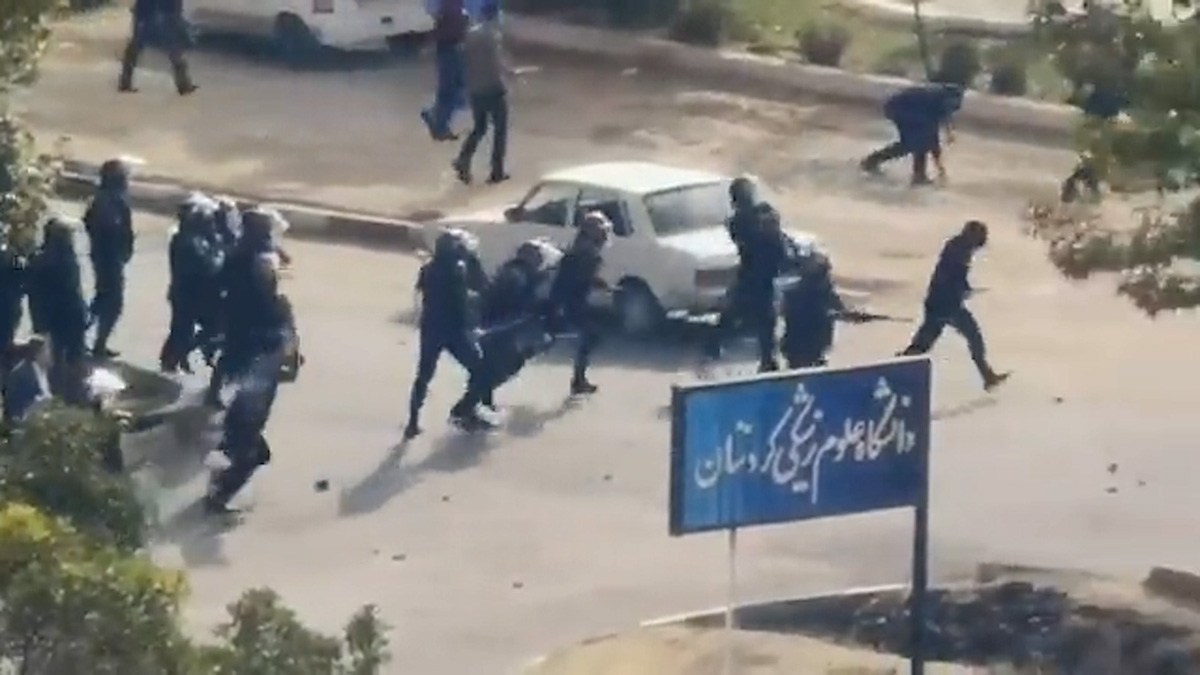
The intricate dynamics between those positioned behind windows and the military forces expose the fluid and shifting nature of conflict between the public and private spaces. What initially seems like a clear distinction between the safety of private spaces and the danger of the streets becomes blurred, as individuals in these private spaces are drawn into the turmoil. The tension between observer and aggressor, between sanctuary and threat, unfolds in real-time, revealing how the boundaries of safety and vulnerability are not fixed but constantly redefined.
The pixelation and degraded quality of images captured from behind windows during the movement are not mere technical flaws but intrinsic to their political significance. As Hito Steyerl argues in In Defense of the Poor Image, pixelated or degraded images “testify to the violent dislocation, transferrals, and displacement.” (Steyerl, 2009:n.p.). Unlike the high-resolution, controlled imagery produced by state media, these fragmented, low-quality videos emerge from censorship and the urgency of witnessing. Their poor nature signifies a mode of resistance, a refusal to conform to the polished aesthetic of dominant narratives. In their grainy, unstable frames, they expose state violence while resisting erasure, embodying the precarious reality of those who stood behind windows, risking their lives to document the truth. The poor image, Steyerl writes, “transforms quality into accessibility, exhibition value into cult value, films into clips, contemplation into distraction” (Steyerl, 2009:n.p.). It is this very degradation that allows the movement’s visual archive to circulate beyond suppression, ensuring that even in distortion, the images remain potent vessels of memory and resistance.
Unlike the high-resolution, controlled imagery produced by state media, these fragmented, low-quality videos emerge from censorship and the urgency of witnessing
While many of these videos filmed from behind apartment and vehicle windows serve as raw historical documentation, others embody deeply personal observations that align with the tradition of autoethnography—a mode of documentary filmmaking and writing in which the creator foregrounds personal experiences through a self-reflexive lens to articulate broader historical and cultural contexts, including collective traumas, shared aspirations, enduring memories, and imagined futures. This method positions the self as a critical site of inquiry, allowing personal narrative to mediate the structural and historical forces shaping collective life. Within the visual archive of the 2022 Iranian protests, footage filmed through windows captures fragmented acts of witnessing that, together, evoke an experience of spatial trauma that is shared with all the witnesses and participants who might be out of sight. By extension, others who once stood behind windows, witnessing the crackdowns on protests, may interpret the footage as a reflection of their own acts of observation when they encounter these videos on social media.
Catherine Russell, in her seminal work Experimental Ethnography: The Work of Film in the Age of Video defines autoethnography as a mode of self-representation that disrupts conventional documentary filmmaking methods by positioning the filmmaker as both subject and observer. Autoethnographic films dissolve the distinctions between the personal and the political, intertwining individual experience with cultural critiques. Such films, in Russell’s words, challenge the traditional authoritative voice that imposes the power and omnipotence of the filmmaker’s gaze onto the political and social misfortunes of the subjects. Opposing this othering gaze, autoethnography encourages the self-reflexive voice of filmmakers. It utilizes fragmented, introspective narratives that highlight the dynamic relationship between the world as recalled and as it is (Russell, 1999:275–280). In several instances within this archive, individuals behind the camera assume the role of autoethnographic filmmakers, not only documenting what they witness but also narrating it aloud, speaking to a friend on a phone call, to family members present behind the camera, or to future viewers expected to come across the footage on social media.
These images, often shaky and framed by the physical barriers of domestic or confined spaces, capture the tension between witnessing and vulnerability, expressing shared anxieties, and the bodily sensation of those observing from the margins of unfolding events. The trembling voices of witnesses, recorded as they film protest scenes through their phone cameras, expose the fragile and perilous position of those behind the lens, embedded within the immediacy of violence and resistance, yet rendered invisible, pushed to the periphery of the visual field. However, it is precisely their voices that offer a pathway to understanding a broader sense of trauma, one that reverberates through the public domain and bears witness to a shared historical memory.
My fragmented memories of the days of unrest in Iran are inextricably linked to the images that persist from the movement. However, the recalled world is inherently fragmented, as memory is intertwined with forgetting. As I revisit these images, I am engaged in the act of weaving a thread, attempting to reconstruct the narrative while also imagining the moments left unraveled—those instances that were not documented and remain at risk of being lost to time. In this process, the tension between memory and forgetting becomes palpable, as I reflect on the unspoken, the unseen, and what has been relegated to the peripheries of videos which continue to haunt the edges of my recollection. Historicizing what is recalled through visual archives requires acts of imaginative reconstruction. Memory, as the foundation of this history, can be understood as an unstable vessel adrift on erratic waves of remembering and imagining, rendering history less a coherent narrative than a fragile and interpretive process. To catch this frantic vessel, one needs to seek an anchor.
In this study, the very frames of the windows serve as anchors for a collective memory. Drawing on historian Pierre Nora’s framework, the space behind windows can be seen as a milieu de mémoire (an environment of memory) where shared experiences were preserved and exchanged through mobile phone videos, ultimately transforming these spaces into lieux de mémoire (sites of memory.) The notion of environments of memory pertains to dynamic traditions in which memory is continuously reproduced through organic social practices. This contrasts with sites of memory, which represent externalized and institutionalized forms of memory. The emergence of sites of memory signifies a pivotal transformation in societal memory, marking a departure from a context in which memory is intricately embedded within everyday life to one where it becomes externalized, formalized, and preserved within designated sites.1 In other words, as sites of memory surfaces, environments of memory disappear.
The visual archive of footage filmed through windows repositions the spaces behind the windows from mere environments of memory into active sites of memory that constitute the foundational elements of this historical narrative. History, in this sense, relies on the testimonies and narratives of those who have experienced the events. Windows, whether as physical locations, objects, or symbolic entities, serve as spaces where the narratives are rediscovered. They reveal scars of the past, safeguarding memories that might otherwise be lost, while simultaneously offering material for historical analysis and interpretation.
At the heart of this recollection is the night my partner recorded video footage from behind the window of our apartment in Tehran (Fig. 3). That night, amid the ongoing crackdowns on street protests in Tehran, we found ourselves confined to our apartment, where the spatial tension between the public unrest outside and the enforced silence on our street became increasingly palpable. From our window, my partner and I could hear distant chants and clashes between government supporters and opponents, yet our immediate surroundings remained quiet. In that stillness, we began to share our thoughts and observations, an uneasy mix of uncertainty, fear, and a growing urge to break the silence. We questioned the quiet of our street: Was it a sign of safety or suppression? Fear or complicity?
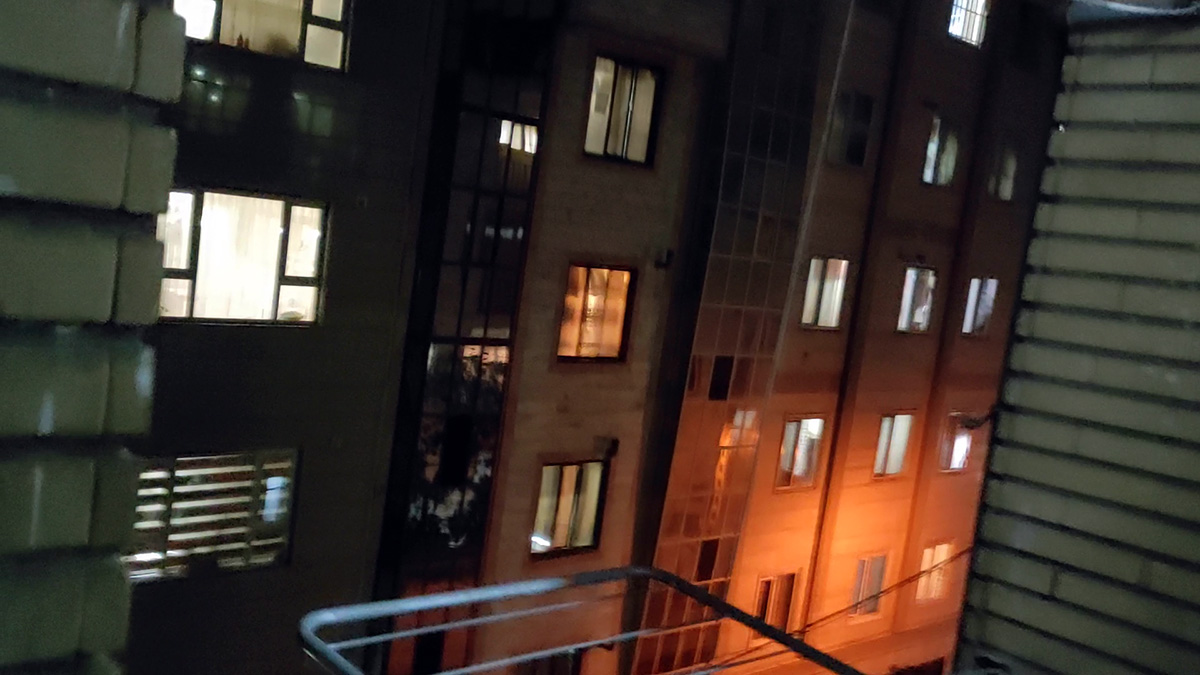
At that moment, we were listening to the slogans resonating from the windows of distant buildings. The window functioned as a boundary, separating our private space from the unfolding events outside. The videos she captured bear three distinct forms of consciousness, as three layers of thread woven into one another—the speaker, seer, and seen—each interacting with the others in ways that complicate the space, making the captured moments not simply passive recordings but dynamic sites of perception. They recall Russell’s description of autoethnographic work:
A common feature of autoethnography is the first-person voice-over that is intently and unambiguously subjective. This is, however, only one of three levels on which a film or video maker can inscribe themselves, the other two being at the origin of the gaze, and as body image. The multiple possible permutations of these three ‘voices’—speaker, seer, and seen—are what generate the richness and diversity of autobiographical filmmaking (Russell, 1999:277).
At the onset of the night, my partner and I stood as the sole seers of the silent street, awaiting the moment when other neighbors would lean out of their windows to echo the rising slogans from afar. In that stillness, we occupied a singular position, caught between anticipation and silence, looking for the first signs of collective action, while the street remained otherwise empty. While protesting in the streets appeared too perilous, the liminal act of deploying our private space, opening our window and sharing our presence with our neighbors, seemed the only feasible contribution we could make at that moment.
That night marked the 40th day since the death of Mahsa Amini, a woman who died under the custody of the morality police due to allegedly improper hijab. By this time, a lot of my fellow classmates and colleagues with a stronger resolve to resist the misogynistic laws the regime imposed on women’s bodies had occasionally participated in street protests. In contrast, I could never bring myself to risk my life. I wasn’t as courageous as they were, nor did I harbor much optimism about the potential outcome of a revolution. Yet, despite my physical absence from the protests, I carried a constant sense of guilt, feeling as though my silence made me complicit. Thus, activating the window became the only way for me to express my solidarity with the movement. Laden with these thoughts, while gazing into the landscape of the street, I found myself grappling with the spatial tensions.
When we started to play a revolutionary song, addressing the issues of the movement through the window, our subtle act of solidarity, confined to the safety of our home, became a form of participation: a way to assert our connection to the larger movement without stepping directly into its risks. It was a resistance, one that acknowledged the limitations imposed upon us while still affirming our collective responsibility. The window framed our perspective, marking the boundary between our private world and the larger, unfolding narrative that awaited its full expression. In other words, we transformed the private into the public, a shift that echoes the feminist slogan “the personal is political.”2 In the videos my partner captured, the phone camera shared the role of the seer with us, while my partner and I acted as the speakers, and the windows of the street became the seen. However, these roles were soon to shift, as our neighbors, moved by our act, opened their windows and joined us with their own slogans. In doing so, they took on the role of the speakers, while our bodies and the phone camera became the seen. In this moment, the roles of seer, speaker, and seen constantly shifted and merged. Each of us, from the neighbors shouting slogans to the cameras recording the scene, became part of a dynamic exchange where the boundaries between observation, narration, and representation were fluid and interconnected, framed by the windows that both separated and connected us. Through the windows, we reclaimed power and symbolically asserted control over the street, thereby wishfully claiming the once-perceived unattainable right to the city.3
Reviewing these videos reveals three interrelated phases of recollection. First, I become attuned to what emerges within the frame of the phone camera and what is relegated to the periphery, either unnoticed or excluded. Second, I recall the presence of neighbors participating in the window protest, envisioning their perspectives to develop a more immersive understanding of the spatial dynamics and the interplay between our actions and voices. Finally, my mind summons countless images captured from behind windows across the country during times of protest, layering these personal recollections onto a broader collective visual memory.
I compiled the footage filmed through windows so as to hopefully solidify the collective memory of the uprising. Although the memory of the ones who stood behind windows might share the same dreams as those who actively participated in the demonstrations, it forms distinct perspectives and roles that do not necessarily overlap with the others, revealing layers of the movement that have yet to be seen. Through the analysis of this archive, I explored the possibility of dialogues between the spaces behind the windows. In certain instances, individuals positioned behind windows documented acts of violence from diverse vantage points. For instance, in the some densely populated neighborhoods in Tehran, where each window of residential buildings and cars serves as a portal to the outside world, people documented the military assault from multiple vantage points. Their footage, captured through several windows, weaves together a fragmented yet powerful visual record, revealing the event from overlapping perspectives and emphasizing the collective experience of witnessing (Fig. 4, 5).
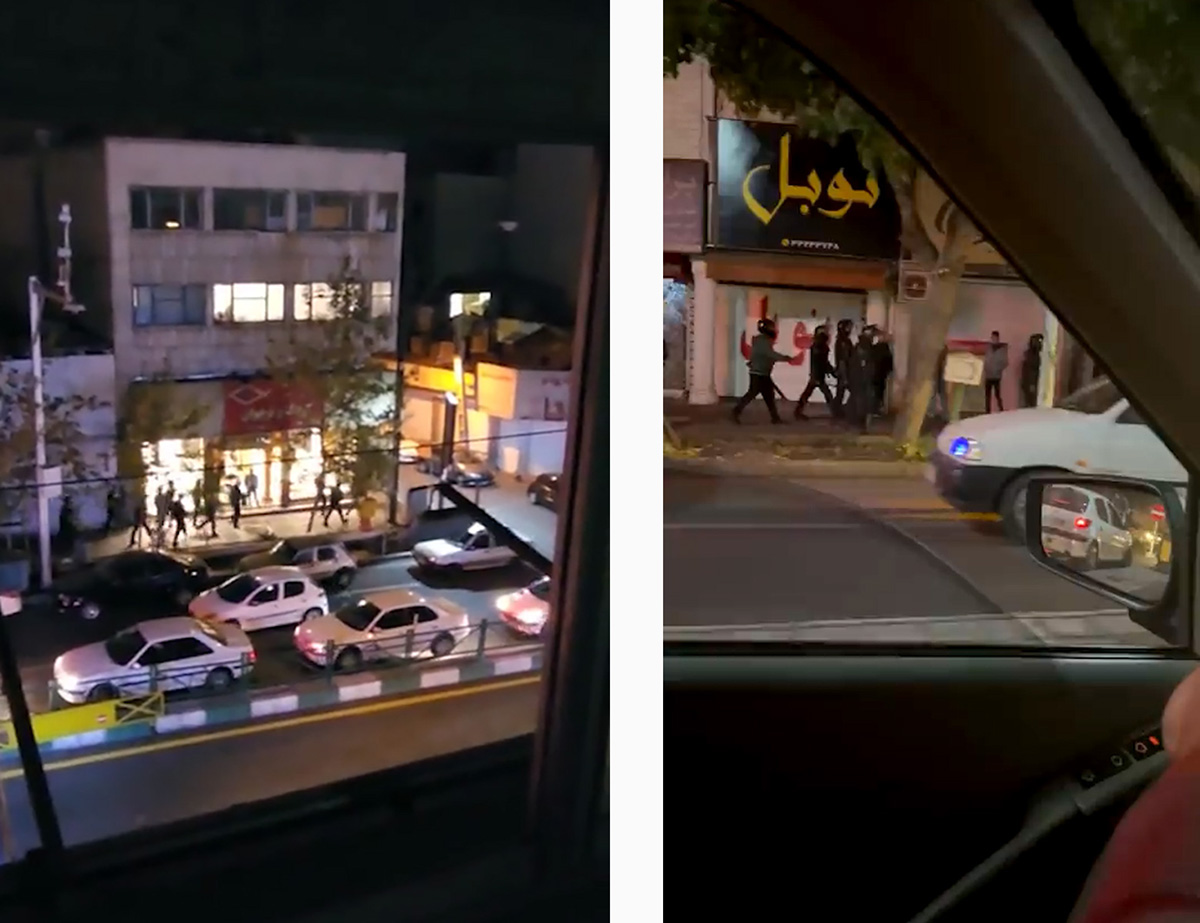
These videos, taken from behind windows, illuminate the spatial violence that disrupts the traditional binary distinction between private and public spaces. Similarly, the methodology of forensic architecture utilizes architectural tools and techniques to investigate and document human rights abuses, environmental degradation, and various forms of violence. The term forensic refers to the application of evidence and scientific methods for legal inquiry, while architecture pertains to the spatial and environmental contexts in which these investigations unfold (Weizman, 2017:9). In examining these videos within the context of the aforementioned movement in Iran, windows, as architectural elements, can also be considered as locations of violence, reflecting both the physical and symbolic boundaries between public resistance and private surveillance. Although this analysis does not directly aim to serve as a forensic investigation into those responsible for atrocities against innocent civilians, it offers suggestions for how the details of the conflict between the oppressor and the oppressed—particularly in the context of the Women Life Freedom movement—can be reviewed through archives, thereby contributing to the advancement of further investigation.
The authorities tasked with suppressing the demonstrations and asserting control over the bodies of those protesting in the streets employed various strategies to permeate spaces of dissent. In some cases, they specifically targeted individuals who were recording footage of the protests from the vantage point of a window. Accordingly, windows can be understood as corridors that bridge private and public spaces rather than rigid borders demarcating the two domains. In moments when homes and vehicles are breached through windows, the distinction between these spaces is continuously destabilized, denying citizens the right to claim personal spaces as their own.
In other words, the residual images of movement, particularly those depicting individuals standing behind the windows of cars and apartments, serve to reconfigure citizens’ perceptions of their lived environment. The city emerges as a panopticon where residents inhabit transparent enclosures surrounding a central axis, an omnipresent surveillance space occupied by military forces. Within this structure, perpetual visibility equates to the state’s control, rendering individuals vulnerable to both observation and violence.4 Consequently, many feared looking out onto the streets from their apartment windows. Their impulse to document the protests and the ensuing crackdown led to an internalized repression, deterring them from exposing themselves to the space beyond the glass. However, there were cases of individuals who rejected such fear and dared to capture videos despite the risk of injury.
windows can be understood as corridors that bridge private and public spaces rather than rigid borders demarcating the two domains
Among these images, several videos depict the moment when the person recording is shot. To commemorate their unlawful targeting, friends and family members shared these videos publicly on social media. The first case is that of Ghazaleh Chalabi, who actively participated in street protests and engaged in public demonstrations. When she was shot, her phone fell from her hand, and the video concludes with a view of the sky and the shocked expressions of fellow protesters gathered around her body. The second case, which is more directly relevant to the current discussion, involves an anonymous videographer who was shot while recording the crackdown from behind the window of her car. Just before the shooting, she reports witnessing security forces arresting protesters on motorcycles, with their faces covered to prevent identification. Moments later, she is targeted; the window shatters, and the scene fades to darkness as the video ends.
The comparability of these two cases underscores the inescapable vulnerability of those documenting the protests, regardless of their physical location. Whether in the open streets or behind the supposed protection of a window, they are both exposed to violence. Windows failed to shield lives and could not safeguard dissenting citizens, and the distinction between private and public space dissolved under the threat of repression. In a similar context, Mohammad Sadeghi, one of the figures actively involved in the movement, was sentenced to five years of imprisonment5 and was arrested while delivering a speech in a live video on social media. The moment of his detainment continued to unfold online, and escape seemed impossible except by jumping from his apartment window. The video, which sparked public outrage, captures a scene in which he is hanging from the window in an attempt to flee, all while framing himself with his mobile phone. Trapped between two windows, one physical and the other virtual, he sought to fulfill his desire for freedom. Yet, neither window provided a path to liberty.
As the camera lens became both a shield and a prison, Sadeghi’s desperate attempt to break free reflects the larger struggle of individuals caught between oppressive systems, as the act of documenting one’s own capture becomes an act of resistance. In the tension between the physical and virtual worlds, Sadeghi’s body, suspended in a moment of vulnerability, embodies the fractured state of resistance, where even the act of escape becomes an expression of defiance. Considering the phones of individuals observing him online at the time as windows into their private spaces, it becomes evident how the ostensibly closed spaces of individuals are, in fact, interconnected. These digital windows blur the boundaries between the public and private, underscoring how movements for freedom and justice transcend physical confines and reach into the intimate, personal realms of those bearing witness.
While Sadeghi’s video paused at the final moment of his detainment, symbolizing the closure of the windows, the memory of their opening persists with all of us who, at some point, stood behind the windows of our cars and apartments, in search of freedom. However, the pixelated image of his face, shouting before our eyes, constructs a seemingly realistic perspective that challenges the notion of unity among those standing behind windows and phones. This perspective underscores the reality that bodies, separated by walls, whether made of glass or brick, are subjected to the forces that, in unison, invade private spaces, compelling submission.
The space in which Sadeghi finds himself suspended, existing between the public and private spaces, disrupts the moment of detainment. This also challenges the conventional understanding of urban architecture as a system of fixed pathways designed to enclose spaces for the purposes of safety and protection. Instead, the built environment can be considered as an interconnected structure. The spaces next to windows, either virtual or physical, should not be understood as opposing one another, nor should they be perceived in contrast to the public space. Instead, they function as interconnected nodes within a dynamic network, disrupting conventional spatial dichotomies and emphasizing fluidity over fixed boundaries.
Social movements inherently represent conflicts between competing ideologies; regardless of whether the outcome favors the suppression of dissent or results in a transformative regime change, one ideological framework ultimately prevails. The determination of victory or defeat is, in part, contingent upon a movement’s ability to assert its presence in public spaces and sustain its occupation. In the context of the Arab Spring, as depicted in The Square (2013), a documentary by Jehane Noujaim, the persistence of protesters in Tahrir Square, Egypt, exemplified this dynamic. The film illustrates how their continued unity and resistance played a crucial role in challenging the existing regime, ultimately contributing to the collapse of the political system in 2011.
In the same vein, among the remaining archive in Iran, there are videos depicting protesters occupying the streets and shouting towards windows, condemning those standing behind them for not contributing sufficiently to the movement. This example underscores the tension between participation and observation, highlighting the perceived responsibility of individuals to engage in the collective struggle in public spaces rather than remain detached. As an individual who mostly remained behind the window of my apartment during the uprisings in Iran out of fear of detainment and death, these videos critically challenge my personal involvement in the movement. Their slogans evoke a sense of complicity in the defeat of the movement, instilling a lingering feeling of guilt that continues to weigh on my conscience to this day, even after I migrated to the United States for educational purposes. Confronting these feelings is what compels me to recall the names, images, and memories of the deceased.
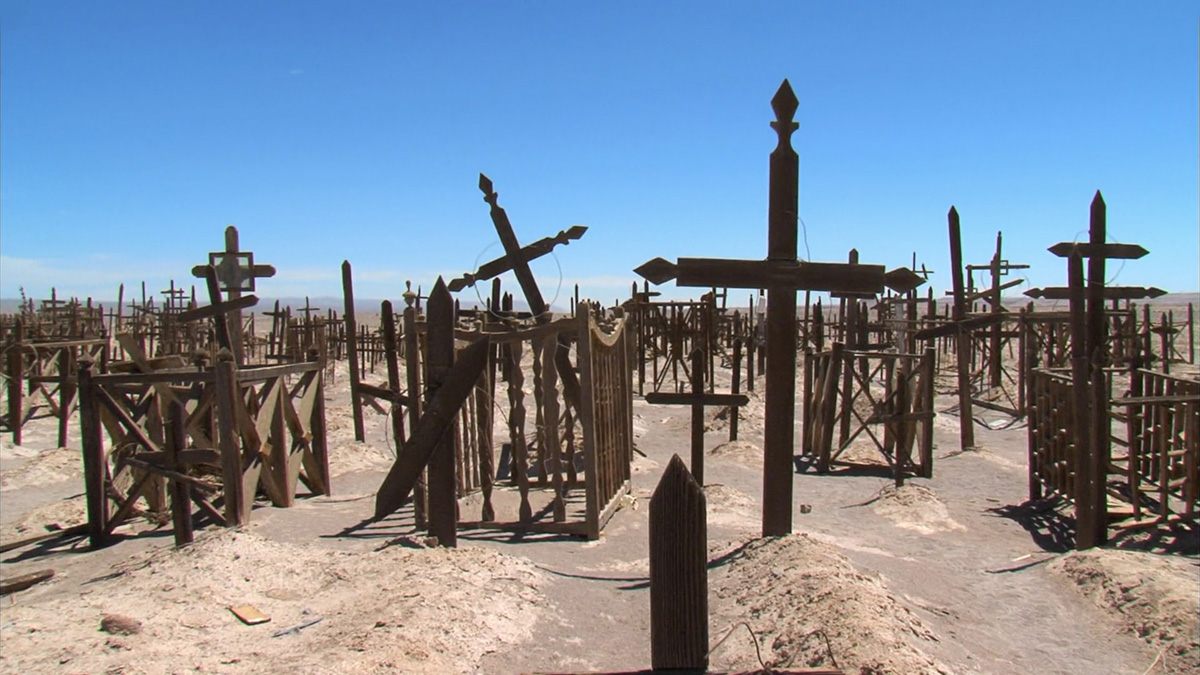
Through the exploration of windows, I seek to situate myself within the temporal and spatial dimensions of the uprising, repositioning the margins of memory, where streets are framed by windows, at the center of this project—a similar trajectory to that of Chilean filmmaker Patricio Guzmán in his documentary Nostalgia for the Light (2010), which juxtaposes two distinct searches in the Atacama Desert: One conducted by astronomers seeking to understand the history of the cosmos and the other by women searching for the remains of loved ones who were killed under Pinochet’s regime, both striving to recover traces of the past, one in the sky, the other on the earth. Similarly, in the context of the Iranian uprising, windows serve as liminal spaces positioned between the terrestrial and the celestial. While they expose the observer to the cityscape, they simultaneously offer a view of the sky, symbolizing the intersection of the immediate political reality and a broader, more transcendent perspective. While the violence unfolding in the streets is disheartening, the expanse of the sky offers a sense of hope.
The image of the sky becomes a symbolic space for reimagining history—one where the blood of the fallen returns to their veins and the forces of violence recall their bullets, undoing their destruction. On the path to such a utopian vision, the vanquished nation must first fully reckon with its collective past, remembering the suffering endured, holding perpetrators accountable for their unlawful actions, and summoning them to the courts of justice. True forgetting, in therapeutic terms that help release the trauma, can only be achieved through the act of complete remembrance. It is in this dialectical process that history advances, allowing the force of the future to ultimately overcome the weight of the past. Nevertheless, it may be the very weight of the past, laden with loss and suffering, that prevents me from envisioning the future, anchoring me instead in the past, entangled with the faces of terror and the names of the deceased. Through the frames of windows, I work to visualize and document a potential history6 of my homeland, Iran, and release it from propagandistic regimes.
The portrayal of the Women Life Freedom movement by the state-controlled media in Iran presents protestors as subversive saboteurs attempting to dismantle social order and incite chaos. Conversely, Western media often portrayed the movement as a reckless and rebellious generation, sacrificing their lives to support opposition groups in establishing a new order. Both representations are problematic: the first distorts the reality of the movement, while the second oversimplifies it, neglecting the individuals who stood behind windows during the period of unrest; although these individuals were disillusioned with the ruling regime, they did not necessarily adopt an overly optimistic view of the revolution, given the historical unreliability of political alternatives. The aforementioned videos expose concealed moments of the movement’s history and construct an alternative historical narrative that resists simplification, instead acknowledging the intricate and complex nature of the movement and its participants.
Acknowledgments
This essay originated as a chapter of my MA thesis in the Visual and Critical Studies department at the School of the Art Institute of Chicago. I wish to express my sincere gratitude to my primary advisor, Shawn Michelle Smith, for her invaluable guidance and support throughout the development of this work. I am also grateful to my second reader, Karen Morris, and my third reader, Joseph Grigely, for their thoughtful feedback and critical insight. Finally, this research was impossible without the crucial help from my partner, Mehraneh Salimian.
BIBLIOGRAPHY
Arendt, Hannah (1998). The Human Condition. Chicago: University of Chicago Press.
Azoulay, Ariella (2019). Potential History: Unlearning Imperialism. London, New York: Verso.
Foucault, Michel (1995). Discipline and Punish: The Birth of the Prison. New York: Vintage Books.
Graan, Andrew (2022). Publics and Public Sphere. Helsinki: University of Helsinki.
Hawkins, Simon (2024). What’s So Special About Private Parts? How Anthropology Questions the Public–Private Dichotomy. Fayetteville: Honors College, University of Arkansas at Fayetteville.
Ho Tai, Hue-Tam (2001). Remembered Realms: Pierre Nora and French National Memory. Oxford: Oxford University Press on behalf of the American Historical Association
Nora, Pierre (1996). Realms of Memory. New York: Columbia University Press.
Russell, Catherine (1999). Experimental Ethnography: The Work of Film in the Age of Video. Durham, NC: Duke University Press.
Steyerl, Hito (2009). ‘In Defense of the Poor Image,’ e-flux Journal 10, 2009.
Endnotes
- 1. Hue-Tam Ho Tai, Remembered Realms: Pierre Nora and French National Memory, Oxford University Press on behalf of the American Historical Association, 2001, p. 915.
- 2. “Changes to understandings of gender roles have affected perceptions of privacy. The feminist slogan that ‘the personal is political’ is based on the idea of making what had been considered private a subject of public debate.” Simon Hawkins, What’s So Special About Private Parts? How Anthropology Questions the Public–Private, p. 51 (see bibliography).
- 3. “Perhaps no other concern is more significant in contemporary anthropology than the analysis and critique of power. [...] The turn to power thus grounded a reflexive anthropology that sought to reveal and critique, rather than to perpetuate, the operations of domination.” Andre, Publics and Public Sphere, p. 18 (see bibliography).
- 4. The application of surveillance employed in the panopticon and its similarity to the case study that is discussed here is inspired by Michel Foucault’s notions in his book Discipline and Punish: The Birth of the Prison.
- 5. Source: www.rferl.org/a/iran-actor-sadeghi-five-years-prison-women-s-rights-hijab/32725710.html
- 6. The concept of “Potential History” is pioneered by Ariella Azoulay in her book Potential History: Unlearning Imperialism, Verso, 2019.