
Human Movie: Six Meditations on a Compression Algorithm | Eryk Salvaggio | 2025
Noise everywhere. Pulsating static, blocky vectorization, grainy and indistinct imagery whose contents are only suggestions of form. Noise that interrupts and deflects. Noise inside images, the grain of photography. Noise generated by compression and the algorithms that make streaming video possible.
Noise is the central image of Eryk Salvaggio’s Human Movie: Six Meditations on a Compression Algorithm. Its sources are varied but familiar: instructional films, found footage from commercials, the detritus and AI-generated slop forced into a dialogue with the noise that infuses every shot. Brief moments of sharp clarity only make noise more apparent as the force lurking just under a veneer of recognition and familiarity, with the video clearly broken by intertitles into six sections which structure the noise that never diminishes. In Human Movie, this noise is the emblem of independence, the freedom that the video suggests is essentially human and which all these AI processes seek to contain and manage by claiming the digital machine is a mirror of the human mind.
Rejecting the products of automation and refusing any suggestion of a machine artist that competes with humans has a long history in confronting industrialization and the automations it made possible.1 Beginning with photography’s release to the public in 1839, this confrontation with images made by automated machinery has prompted both critical rejections and paradigmatic embraces of the same inhuman mechanisms that AI generative systems expand and extend. In place of the prosthetic recording machine—the camera—the diffusion model offers a prosthetic dreaming where human imagination is quantified into an assembly and recombination process. This is the challenge and the terror that runs beneath the surface of Human Movie: it is an uncertainty about where the human mind belongs in relation to this machine whose images transform ambiguity into precision, uncertainty into a fixed, singular outcome. A mechanical demiurge emerges from these operations, a technological solipsism, developed and modeled on human imagination without the inscrutability of those biological caprices that differentiate the living from the mechanical. Instrumentalizing human intention invites understanding human creativity as nothing more than a mechanical process that recombines found footage in seemingly novel ways.
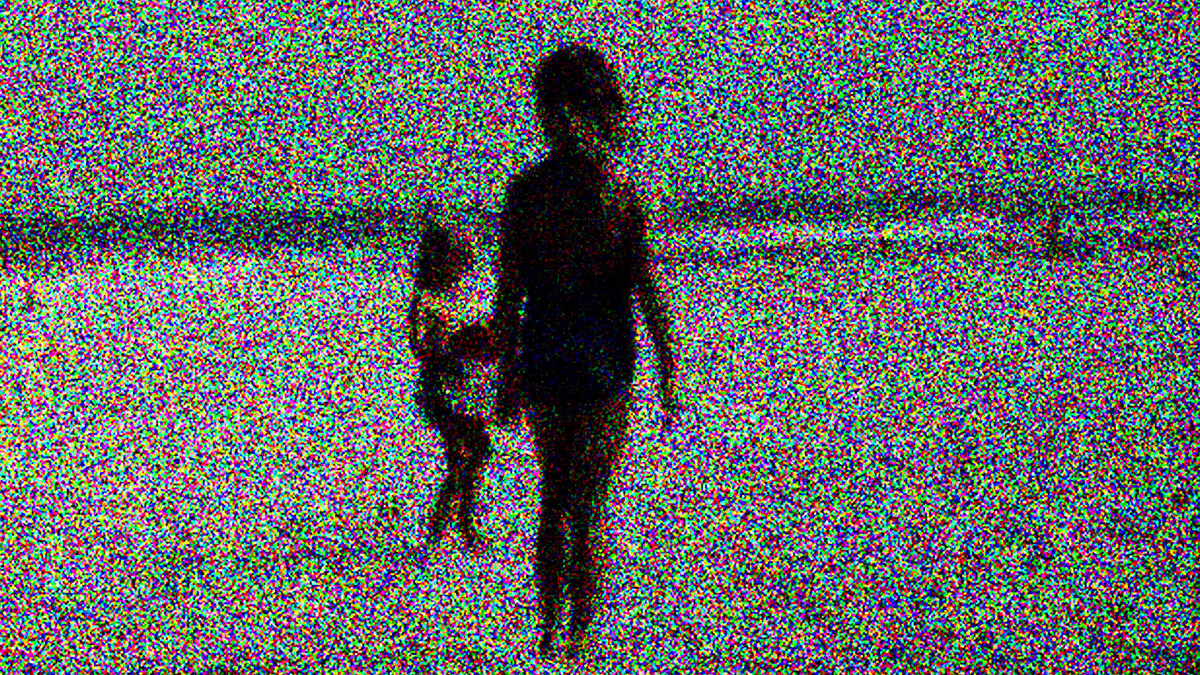
Crucial to understanding Human Movie as a dialogue between human and automaton is its presentation as expanded cinema: the soundtrack is performed live by Salvaggio, who questions the machinic perfection that reduces and eliminates noise,2 interrogating the AI that produces many of the images in this performance. His opening narration lays out the problem as a hidden relation between the artist and the LLM (Large Language Model) AI system:
Communication technologies were built on the eradication of noise. The effort has been remarkably successful in some ways. Information is being transmitted globally in near real time, and the once desperately awaited delivery of information has become overwhelming. To handle this overwhelming situation, we’ve turned to a new kind of filtration system: the algorithm, which can identify signals and amplify them for our benefit. Conceptual noise requires a conceptual filter. Today, this task has a name to cope with the onslaught of artificial information. We turn our decisions to artificial intelligence. As I typed this, the artificial intelligence system suggested that I rewrite this paragraph to make the audience feel confident about AI’s role in the future of information management. I rejected the suggestion.
Salvaggio’s refusal “to make the audience feel confident about AI” is an important admission. It acknowledges that AI affects not only the imagery, but the text he reads. It directs attention to a struggle for dominance and control that is otherwise hidden within the transformations of noise-into-imagery. Using automation (AI) is not automatically a positive development, and the suggestion that it should be frames the ideological dimensions of Salvaggio’s critique of technology. The prominent role of artificial intelligence (AI) as neither comforting nor trustworthy as it controls information invites the acknowledgement of the human voice that slips and shifts in live performance. The relationships of text-to-image—never actually synchronized, but neither disconnected from them—become an expression of individual subjectivity apart from the normalizing and dominating processes of automation; thus the title Human Movie is an appropriate description for these relations. The essential role of the human narrator who interrogates the images onscreen gives each section its distinct focus and critical depth, while at the same time raising doubt about it—how much of this text was written by AI? How many of these doubts are not actually human doubts, but the statistical probabilities of a machine processing language?
What emerges from Human Movie is a critique of the new digital technologies that reconstruct the world through a constrained, statistical process, a process that cedes human judgment and nuance to a descriptive apparatus built to manage a predetermined message. The signal that the AI discovers within the noise is a product of its programming and the assumptive priority given to coherent forms. But the noise that fills all these images is both a disruption of their coherence and the vehicle for their capture because the AI’s operations begin with random distributions of pixels and progressive transformations that render them familiar. Noise is captured and tamed. This imposition of control turns the otherwise chaotic seething into idealized, mundane pictures whose movements change direction through uncanny matches in shape and motion—figures abruptly reverse to face the camera, their backs becoming their fronts; jumping turns into a weird flying, ungrounded from familiar reality. These reversals happen because the machine does not know what it does, merely matching patterns found in the noise to those contained in its data. As Salvaggio explains:
At the heart of our current wave of AI-generated images is literal, static. What in any other context would be a corrupted file? The machine has processed countless images, stripping information out of phases, then traces the paths back to the original. Along the way, it makes a map of coordinates, and when we type [directions] into the system, it generates a new image of noise, millions of pixels set into the random murmuration of color.
The mind proposed by these systems is one unconstrained by history, culture, psychology—a mind without biography, a mind that cannot name anything but must instead constantly seek to create order without meaning. It contrasts with the voiceover that explains images without acknowledging their contents, aside from the noise, which always returns to the inchoate substance that awaits organization-without-identification. The temptation to understand these autonomous changes poetically, mythically, is an error. Projecting a consciousness into the AI machine is the fallacy: these images emerge from instrumental activities in the same ways as other industrial processes; they are strictly guided by mechanical principles and they depend on the human encounter to become sensible.
AI transforms all the critiques of authorship from the twentieth century into an apparatus that erases human agency. Without a consciousness, these generated products must return to the noise that produced them. Magic and alchemy are the enemies to this process of control, but they are invoked in confronting it because the human mind does not apprehend the technology that actually guides this result. The machine is always hidden from view by what it produces.
Developing these differences between the human artist and the machine artist informs the six sections in Human Movie, providing focus to what are a series of digressions and tangents confronting AI: Learning, Temptation, Creativity, Image Recognition, Memory, Logic. Their progression seeks ways to separate machine and human, but this difference is never assured—it must instead be developed in a Socratic process of questioning our assumptions about what is human and how we are different from the machine. This crucial understanding reconceives the noise that AI systems assume. It is the implicit order contained in the Shannon-Weaver model of communication that guides the construction of these machines: there is no actual noise, only patterns awaiting recovery from within the pulsating static that fills these images…3 The world has an internal, hidden order that the ideological beliefs about AI claim only it can reveal.
Whose “noise” do we confront in/as AI? Section 2, Temptation, explains these transformations of noise into coherence as the foundation of the image-generation process used to make the AI videos in Human Movie. The narrator forces us to consider questions normally ignored or answered through familiar expectation. Theories of noise abound in twentieth century criticism—Attali, Adorno, Jameson—but instead of these ambivalent approaches, what guides the AI system is the Shannon-Weaver model of communication where noise is a disruption, a deviance from the signal that is the real, the true focus.4 This internal message is axiomatic, an assumption whose confirmation bias guides the machinic process of its identification and presentation for the human audience. Security versus entropy. The quantity of noise in these images challenges the understanding of them as glitched, rendering the emergent images as an unstable order which continuously requires support and reaffirmation to exist. Noise is not corruption but the baseline reality, the image itself becomes authoritarian control—a machinic ordering—that eradicates anything that does not neatly align with the data biases shaping perception.

Embracing uncertainty is a radical gesture when confronting automation generally, and AI systems specifically. Each successive pass of AImage generation advances towards greater certainty about what the noise “really” contains, what the image “is.” To insert uncertainty into this process decenters this modeling, challenging the metaphors created by AI systems that challenge the role of human judgment as the sole decider of what matters to civilization. This dehumanization appears as an algorithmic spectacle created by the parasitic operations of computers transforming and reassembling the fragmented human culture their databases have consumed, transforming culture into a construct that is merely awaiting recombination.5 These issues in the sections called Image Recognition and Memory are inherent to the autonomous eyes that generate endless new worlds as distractions from the one we inhabit, offering a continuous stream of images which melt into air, weightless replacements for our own imagination. This critical apprehension of AI systems reveals their creation of a hyperreality without importance or significance that vies for dominance against the subjectivity of their audience and the very human concerns with distinguishing reality from fantasy: “AI is not an escape; it is what we need to escape from.”
AI only imitates certain states of mind. Data processing machines are built and operated as reifications of human metaphors6 but machines do not remain reflections of their subjects. The particular model of consciousness artificially created for each new technology begins a new feedback loop that reshapes our self-conception in its own image. Salvaggio interrogates these paradigms, which model a “mind of fear” that seeks to grasp an ambiguous and unstable world as a fixed and precise order in Human Movie. They are the subject of each meditation whose Cartesian origins are readily apparent in the formulation that concludes the narration: “I doubt. Therefore I think. Therefore I am.”
Endnotes
- 1. Gabor, D. Cybernetics: Art and Ideas, edited by Jasia Reinhardt (London: Studio Vista, 1971), p. 18.
- 2. Barker, T. ‘Aesthetics of the Error: Media Art, the Machine, the Unforeseen, and the Errant,’ in Mark Nunes (ed.) Error: Glitch, Noise, and Jam in New Media Cultures (New York: Bloomsbury, 2011), p. 45.
- 3. The Shannon-Weaver model was proposed in the 1950s as a description for minimizing noise in electronic circuits and broadcasts: messages proceed from their source through a transmitter into a channel which conveys it to a receiver and finally on to its (human) destination. It highlights how interference (noise) is a disruption to this process, an external factor that impinges on the communication being conveyed.
- 4. Shannon, C. ‘A Mathematical Theory of Communication,’ Bell System Technical Journal, vol. 27, no.3 (July 1948), pp. 379–423.
- 5. Rose, G. ‘On the Relation Between “Visual Research Methods” and Contemporary Visual Culture,’ The Sociological Review, vol. 62, no. 1 (2014), pp. 24–46.
- 6. Dosi, G. ‘Technological paradigms and technological trajectories: a suggested interpretation of the determinants and directions of technical change,’ Research Policy, vol. 11 no. 3 (1982), pp. 151-153.