
A Conversation with Tessa Hughes-Freeland
Tessa Hughes-Freeland is British-born experimental filmmaker who has used found footage in her work for many years. She studied history of art at University College London, where she aligned herself with the radical performance artist Stuart Brisley. After graduating from UCL, Hughes-Freeland pursued an MA in cinema studies at New York University, where she also completed a course by P. Adam Sitney, working as his teaching assistant at the Cooper Union.
Hughes-Freeland has written about film in the East Village Eye, Paper Magazine, and the Underground Film Bulletin. As part of the downtown No Wave scene in the late 1970s, she met people such as the Three Kens, who owned a film club and rented out Super 8 cameras that allowed her to make films. She also collaborated for many years with the Cuban-born, New York-based artist Ela Troyano. In the early 1980s, Hughes-Freeland started programming at a club called LIMBO amongst a growing community of artists who were active in the neighborhood. With Troyano she started the New York Film Festival Downtown in 1984, a three-day festival which ran for five years. Hughes-Freeland also served as President of the Board of Directors of the Film-Makers Co-Operative from 1998 to 2001.
Her found footage films have screened internationally in North America, Europe, and Australia, and in prominent museums and galleries, including the Museum of Modern Art (MOMA), the Museum of Contemporary Art in Los Angeles, the Whitney Museum of American Art (NY), the New Museum of Contemporary Art (NY), and the KW Institute of Contemporary Art (Berlin). She has collaborated on live multi-media projects with musicians like John Zorn and JG Thirlwell.
Rachel Garfield: Tessa, it is great to be here today to discuss your work with you. Can you tell me how you got into filmmaking?
Tessa Hughes-Freeland: As a child I lived in an area that was near Pinewood Studios in England, and I would often see horror films being shot in Black Park in Buckinghamshire. There were a lot of people who lived in the area who were involved in the filmmaking business.. I was shown some of the studio sets and was in awe of them. I was also struck by an area filled with props; sticking up out of the top was a statue of Peter O’Toole from Lawrence of Arabia (David Lean, 1962). Also, Roger Moore lived around the corner from my house and he had a car with RM1 on the number plates. I also spent rainy afternoons watching Hammer horror films. I think all of this contributed to a sort of fluctuation of perception between reality and filmmaking.
My dad was an avid home moviemaker, and he would direct us a little bit to suit his home movie needs. When I was little, I would help him make intertitles, which, in this case, were just titles of places where most of the films were made. I also watched him edit. He would direct me to take certain actions—”come down the steps, walk over there and then sit at that table”—so I was acting in films without really knowing it from quite a young age. You know, I could see the behind-the-scenes tools that went into filmmaking and I was fascinated by them.
R.G.: So you were surrounded by film in almost every way, both privately and in your neighbourhood milieu and also through the industry.
T.H.F.: Yes, and in that, I felt the magic of it. The magic of the illusion.
R.G.: Moving to your adult life as a filmmaker in New York, I have a question about the New York Film Festival Downtown.
T.H.F.: The festival encouraged expanded cinema, and we also had emcees in between the changeovers. It was somewhere between cinema and theatre. Also, there were filmmakers who worked with dance or dancers who were engaged with artists who performed in tandem with film. It was a very fluid situation. It wasn’t just a projector and a screen.
I think probably one of the most important developments for me, in working with found footage, was that when Ela Troyano and I were producing the festival, we often didn’t meet the deadline in finishing our own individual films, so we would work together doing live multiple-projection performances as a part of the festival.
R.G.: So when you were projecting films and doing these projection performances, you were projecting found footage at that point as well? Or was it shot footage or some kind of mixture?
T.H.F.: It was mixed. And it served to develop this relationship that incorporated not only moving images but slides and other objects as well.
R.G.: You mentioned somewhere that you were struck by two films at college, both early Expressionist films: The Golem (Henrik Galeen and Paul Wegener, 1915) and The Cabinet of Dr. Caligari (Robert Wiene, 1920). Could you tell me a little bit about what it was in those films that captured your imagination?
T.H.F.: I think what primarily impressed me was that they were silent. I hadn’t really been exposed to a huge amount of silent film. In terms of The Cabinet of Dr. Caligari, it was really the set[s] that impressed me. They had an apparent low production quality, even though it wasn’t particularly low; the handmade element of [the film] that was visually clear, between the Expressionist sets and the makeup and the exaggerated gesture[s], it seemed somewhat comical. It made the film somehow accessible in that I felt that maybe I could do that. It also seemed more playful than professional. In terms of The Golem, I loved that it was a folktale with a slight monster or science fiction quality. The Golem was reminiscent of an Egyptian mummy or sarcophagus.
R.G.: In many of your films you chose to use choose dramatic moments from other films such as the footage of Tarzan, and your use of film noir. You have used this as an expressive gesture in the films that you make as well.
T.H.F.: Yeah, that’s right. The gestures are in lieu of words.
R.G.: The use of intertitles, for example in Gift (2010), a film where the main imagery is brought from early black and white films Alice in Wonderland (Norman Z Mcleod, 1933) and Sleeping Beauty (Julia Leigh, 2011). In Gift you overlay colored gels from time to time and several other types of found footage through a fast pace edit. Some footage that moves through the film is abstract such as diagonal stripes or green or pink tints. The interlacing of these different forms of footage densely packed and montaged give the imagery a floaty quality of instability. This sense of anxious instablitly is augmented by Marc Abramson’s pulsating soundtrack. Occasional intertiles, also taken from Hollywood films are used to contradict or critique what is being seen on screen. You know how to use words and images in a unique way, other than them just being background audio or having a narrative purpose. By putting seemingly random intertitles that disrupt the flow of the imagery, your use of intertitles opens up a space for the imagination in the disparity you bring to the film between word and image.
T.H.F.: My use of intertiles positions the work somewhere between a book and a film in my mind. When I first saw the found footage that I used, I found it really interesting, because some of the intertitles are like sheets of paper, although not literally of course. I’ve always been attracted to films where there is a hand that turns the page at the beginning, to indicate the start of a story that then fades into the film narrative. I think it’s a cheesy effect, but I really like that.
RG: What you’re talking about is storytelling. And there’s a tension in your work between a certain kind of storytelling from some of the found footage and the way you put things together in which there’s an absolute refusal of storytelling. There’s no denouement—the films just seem to start and stop as they are not driven by a linear thrust. Your films are structurally abstract, and it is the juxtaposition of imagery that tells a kind of story. So it’s quite interesting that you have told me in the past that they are like a kind of storytelling, because of course the intertitles in silent films are very much about telling the story in moments when the visuals couldn’t do that. There is a dramatic contradiction at the core of your work.
T.H.F.: Sometimes I use pieces of narrative film, but I like to throw in storytelling devices without them being used in a linear way. For me it is more about the process of making the multiple-projection pieces. The difference between making them and watching them is that when I’m making them I’m constantly reacting to the material spontaneously. It’s a process that’s akin to creating a painting. You know, it’s a constantly evolving, spontaneous creative process that I get deeply involved with. I decide whether it’s complete or successful in matching my intention. I do have an intention in terms of choosing and deciding on all the elements that I want to include.
R.G.: How did your re-use of material emerge? And what is your fascination with it?
T.H.F.: I realized that images are just signifiers and they trigger emotions, and at a certain point I was thinking that I might not need to shoot anything, that I can just find an image that will correspond to what I want to express. I’m sure that if I’m thinking of an image and I’m going to shoot it, there’s probably that footage in existence somewhere already. If cine-semiology is film language in its most basic form, there’s an iconographic language that is pre-existing. I just need to find it somehow; [for example] by combining two images I can create a juxtaposition or combination that will have a desired effect.
R.G.: I do want to talk about the painterliness in your work, which is also reminiscent of constructing or building, because you tint the image or overlay footage in a way that is like a collage. How do you build constructions of different images that overlay each other and comment on each other? Such constructions also create a texture or mode of attention.
T.H.F.: I’m interested in the way that the films can make themselves. When I play around with the different films that I think I’m going to use, if I find that there’s a dialog between the two films and what I’m doing, then I pursue it. I’ll try different things together and then, when I think I’ve found something that works together well, I’ll keep it and continue working with that material.
I realized that images are just signifiers and they trigger emotions, and at a certain point I was thinking that I might not need to shoot anything, that I can just find an image that will correspond to what I want to express
R.G.: How do you tint the work?
T.H.F.: I use gels. Just as painters sometimes have their favorite iconographic elements, I’ve got my favorite elements that I use, and for tinting, my preference is generally gels.
R.G.: How did you start using gels and what do you like about them?
T.H.F.: The first time I used gels was when I made Play Boy (1984), in the parts where I divided up the screen into colored panels. Using gels helps to dull or change the color; it makes it easier to blend one piece of footage in with another. It creates a unifying surface and a blending of the parts. Similarly, because I’m working with a few projectors that often have different frame sizes, I’ll also try to use some kind of mattes, but most of the matting that I use is actually made with my hands—my most used tools are my fingers.
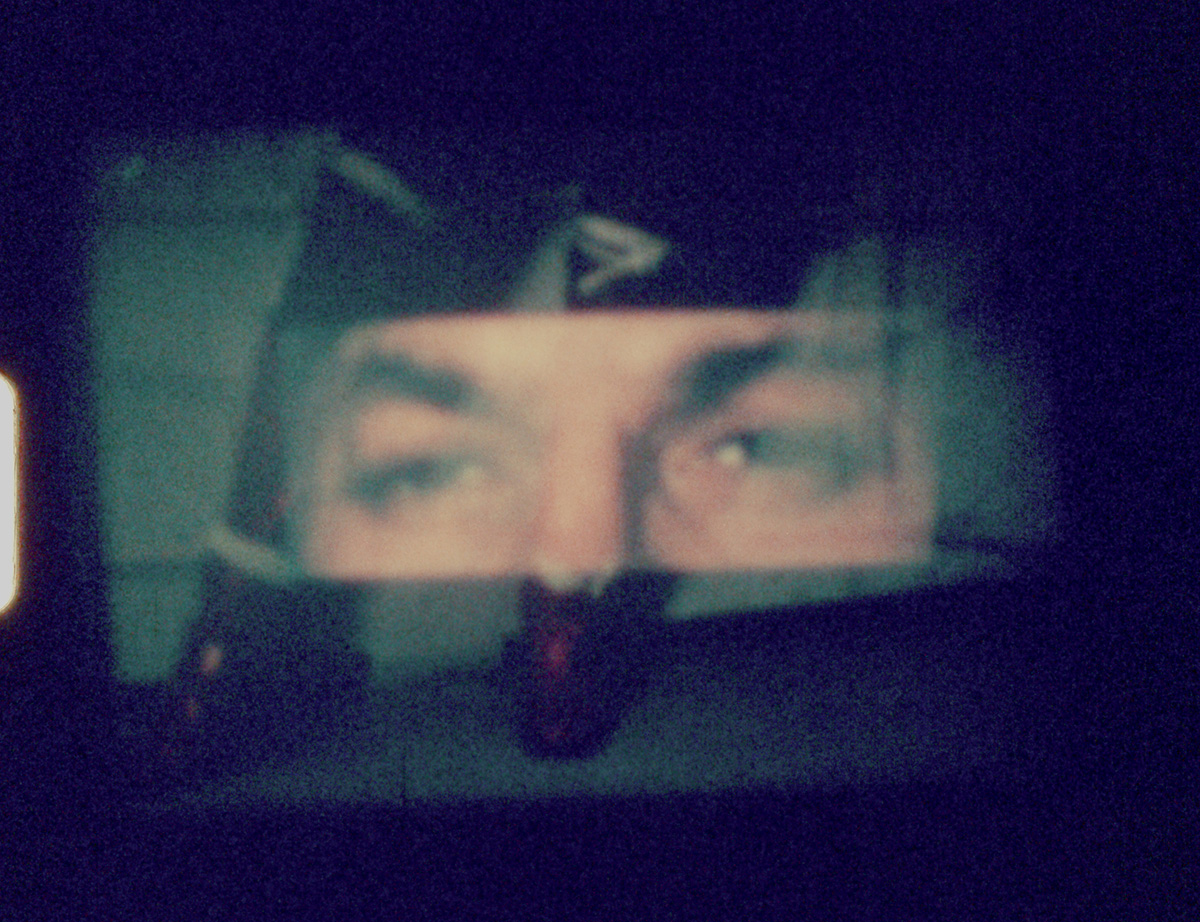
RG: So it really is a handmade film! And in terms of composition, they’re quite dynamic compositions. Is composition something that concerns you? That might seem to be a contradiction, since you talk about playfulness quite a lot. It seems to me that you play around a lot with chance and how things happen to fall onto each other.
T.H.F.: Yes, chance and spontaneity are very important in making these. Once I’ve decided what elements work together for me, then I’ll do multiple passes and I’ll find out which ones work and I’ll keep them. I am looking for dynamic compositions or chance occurrences that contrast or surprise. I’m ultimately doing it live and I’m reshooting it. Sometimes I leave the entire pass as one piece, but more often than not, I’ll edit pieces together.
R.G.: When you say reshoot, do you reshoot from a computer screen or from a projection? And what do you shoot with?
T.H.F.: That’s a good question. I reshoot from a projection, and I’ll get the framing as tight as possible. I shoot from a projection rather than using something like an optical printer because it’s more fluid and I can manipulate it more.
Typically, I’m using about three image sources that change during the piece or during the pass. It’s usually a projected mixture of Super 8, 16mm film, and slides. I also implement filters, crystals, refraction objects and mattes and netting—anything that I think works. What else? Different objects that can manipulate the image. I’ve just started using the occasional laser projector.
R.G.: So it is quite performative as you’re doing it, which relates to the beginning of the performed projections at the New York Film Festival Downtown with Ela Troyano.
T.H.F.: Yes, absolutely. In fact we continued working together in that capacity for about twenty years.
R.G.: So what camera do you shoot with?
T.H.F.: I used to work with a Super 8 camera or a 16mm camera. I’ve used both of those. But now I do use a video camera to record it tightly, because I want the image to be as clear and as bright as possible. When I’m doing this, there is a flicker, of course, because the image [originates from film]. I’ve learned to incorporate the flicker. I like the flicker. Sometimes, in the translation from film to video, some really interesting things will happen, like there’ll be a burnout or there’ll be a flare. If there’s a lot of white on the screen, then this sort of yellow appears. I work with that because I like to embrace those kinds of accidental occurrences.
R.G.: Can I ask you a bit more about the video camera? Are you talking about a mini-DV camera or 4K?
T.H.F.: I’ve used everything. In my life I’ve been through so many different formats. The answer is yes to all of them.
R.G.: Is that something you enjoy, the different textures of the cameras, or is it just whatever happens to work or whatever you happened to have at hand?
T.H.F.: The mini-DV cameras were small, but they produced a small image, and that’s not really going to work for me now, you know. So I’ll use whatever produces the best quality image and can be synchronized to the editing systems that currently exist. I mean, I’m not opposed to using my iPhone; actually, the real answer to that question is, the smallest camera possible. The iPhone is not great because it’s quite wide. I’m trying to get the camera close to the projection beam without creating a shadow on the screen so that the image is as even as possible
R.G.: Your film Baby Doll (1982) is one that was shot by you. It has a very different feel to it in some ways than your found footage films. Obviously, there are similarities in terms of the interests you have that bleed throughout all your work. How did you shift from the documentary to the found footage approach to filmmaking?
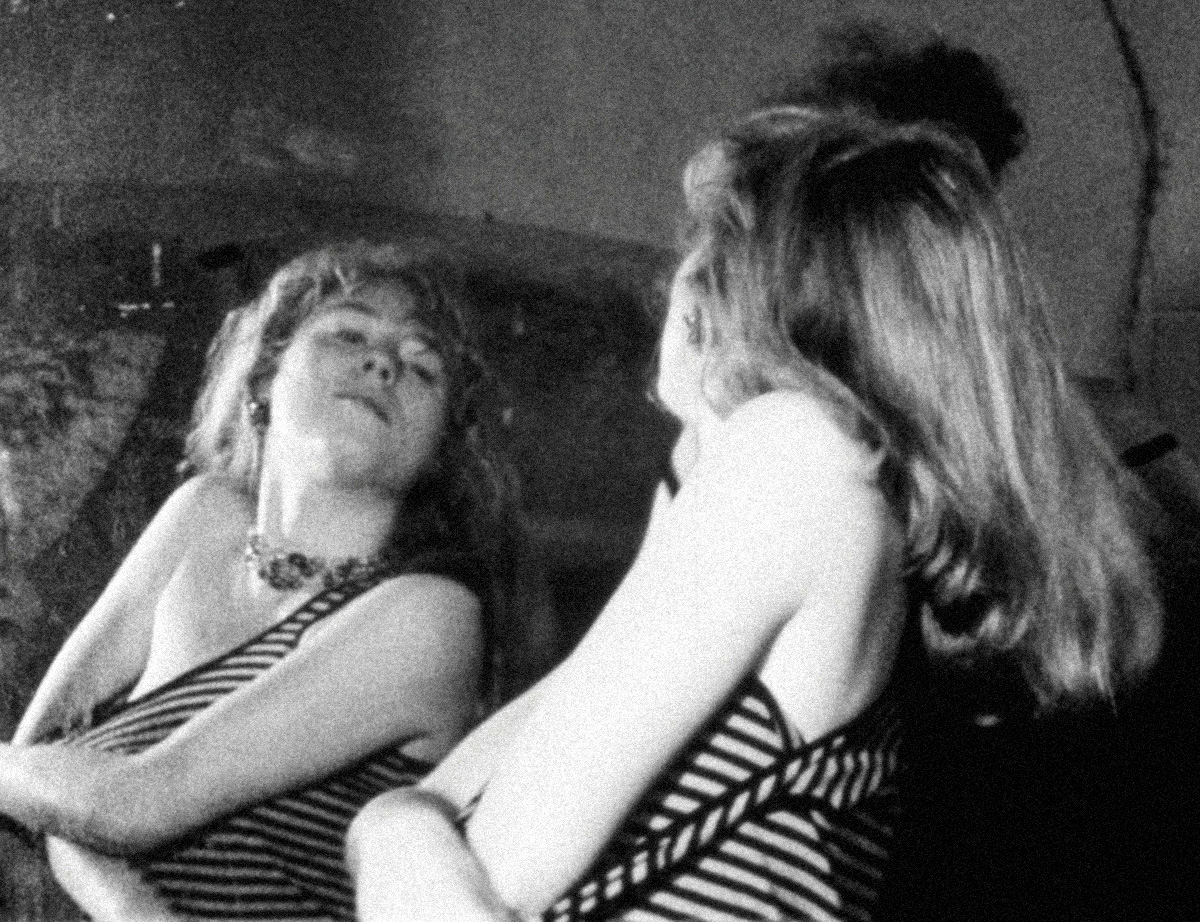
T.H.F.: Well, I’m probably going to say the thing that nobody ever really wants to talk about, which is that it was largely economical, but also technical. Baby Doll was shot in 16mm with three prime lenses. The reason for the shift from original to found footage was that I wanted to make a film and I didn’t have enough money to shoot much film. The film I made after Baby Doll was Joker (1983). I found this store that sold abbreviated versions of Hollywood films and incorporated those. I used the found footage to create some characters to complement the original footage. At the same time, I found all these stores on 42nd Street that were giving away their porn films, which at the time were mostly Super 8 and 8mm. I made Play Boy combining Hollywood movies and some of the porn film footage. That was the first film where I used the combinations of images shifting from one to the other, with some overlapping. It was shot using a handmade rear-projection screen, which resulted in a vibrating hotspot, which I love.
R.G.: I think it’s important to talk about economics, about how you can make work with no money.
T.H.F.: I think it’s kind of a shame that people would rather talk about choices made in their work as a creative decision and are reluctant to admit that one may be driven by economics. But the situation for me was a matter of being inventive and creative, born out of necessity. And I really liked what occurred when that happened. When I made Play Boy, I really liked the juxtapositions and playing around with images, and that’s when I decided that images are already out there as preexisting images that I can use to communicate what I’m interested in expressing.
R.G.: My impression has been that your films are all full of women. There are indeed, many women in all your films but looking closely through a selection, I’ve noticed that there’s also quite a lot of men in your films, for example Tarzan and cowboys from Hollywood movies. And then there’s one film that’s very specifically focused on the idea of men, Watch Out! (2007), which uses educational footage at the beginning—sports bringing boys to their optimal performance level—which you overlay with a heavy red tint that gave an ominous mood to the work. I found that fascinating and really powerful.
T.H.F.: In various films there’s footage of the boxers, and boxing—they are all stereotypes really, boxers, cowboys…
R.G.: Tarzan and Jane are really obvious fictitious gender stereotypes, but boxing doesn’t feel so much of a stereotype because it is such a part of the sports genre, and it’s on TV with a large audience.
T.H.F.: I think the footage of boxers feels a bit less exaggerated, shall we say, in terms of its representation, and I often slow it down. I don’t know, but I think I was really using the boxing films for the concept of physical impact.
R.G.: I think all your films are very physical, and maybe that’s also the attraction of film noir as well, because the women in film noir are very active, aren’t they? They have a lot of agency and they do things like shoot people and light cigarettes and move meaningfully.
What about the intertitles? That is something that interests you, the use of words in films.
T.H.F.: A lot of the found footage films have subtitles at the bottom. I decided early on that I was going to leave those in when they occurred. At a certain point, I decided that I wanted to create some myself, so I shot slides from a number of films and I interjected them into the found footage. For example, I included them in my film Gift, which in itself is a double entendre between the German word for a poison and the English word for a present. The main spine of the found footage in Gift is taken from the films Alice in Wonderland and Sleeping Beauty, so it’s about intoxication of a certain kind. I thought that an appropriate subtitle to throw in there would be “Sometimes reality is too complex”—a subtitle that I took from a Godard film. I’ll do that occasionally, but most of the time I work with what’s already there.
R.G.: There are some great interventions, like in Instinct (2007), with the man telling the woman what to wear!
T.H.F.: Yes, he says imperiously: “Next time I see you, I want you to be wearing white.” I repeated that several times, and then he takes his walking stick out of the stick holder and he holds it out towards her. For that part I did this intense strobing of the images. For Instinct I used two identical films overlayed but that are off register so I could make slight or great changes in that way.
R.G.: Then, in the next sequence in Instinct, Mae West is wearing a glitzy, overtly sexy dress, which is absolutely the opposite of what this man is saying he wants.
T.H.F.: Yes, there’s a lot of humor in the works as well.
R.G.: I think that’s part of the play, isn’t it? It allows you to create both menace and humor while extending and expanding the expressionism that you embrace in those early silent films. In that sense, Instinct is like a kind of progression of a silent film into the contemporary era.
T.H.F.: I suppose so. Definitely, with respect to the fact that the film sources are all black-and-white and I then add the color.
R.G.: I was particularly struck by the color in Instinct, which is an orchestration of purple and yellow.
T.H.F.: Yes, that combination is one of my favorites. They’re not exactly complementary colors, but close. [The footage is] all from black-and-white [films], except for Nowadays (2020) where I used color films. Nowadays was completely different because I made that during COVID. So I actually combined digital footage along with projected analog film footage.
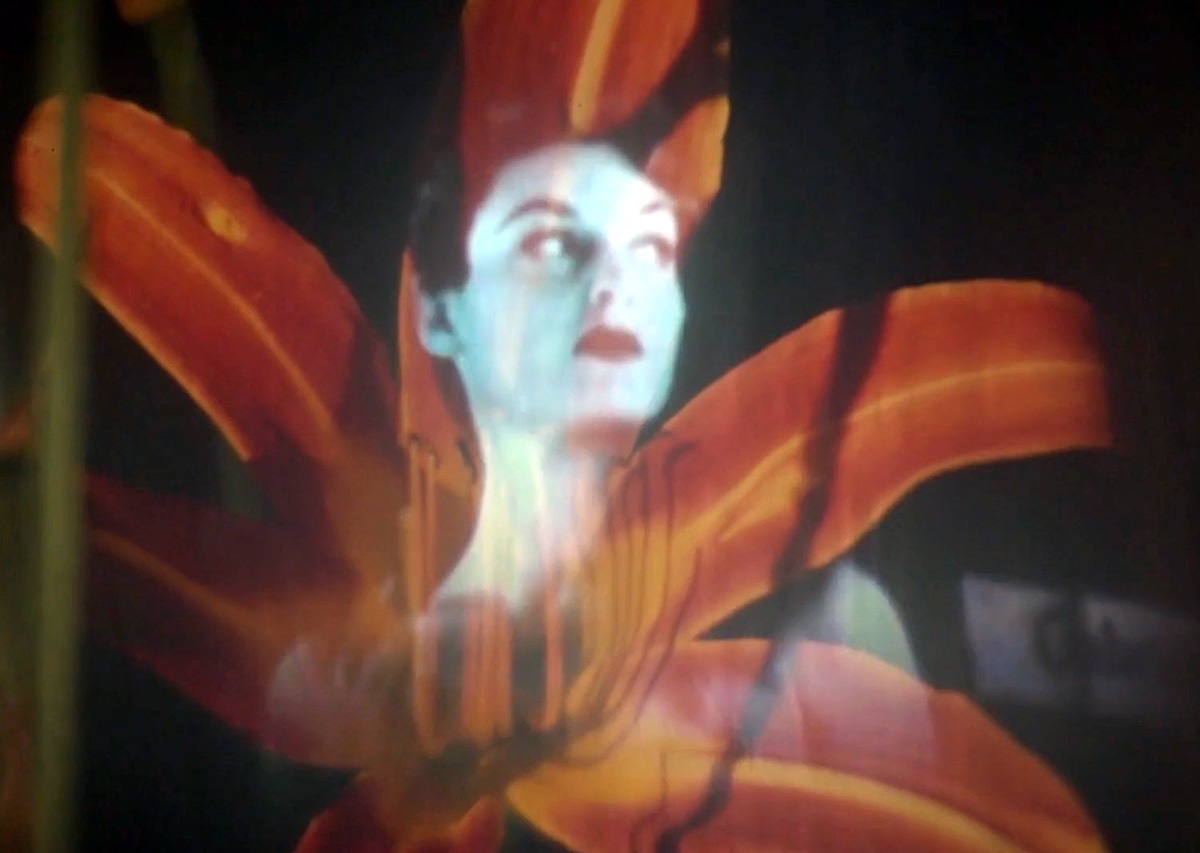
R.G.: I’d like to talk a little bit about Hippie Home Movie (2013), which is delightful. I really love that film. It looks like you’ve combined some newly shot footage with some found footage. In the beginning you move from a treated image of a lake that is heightened to acid greens to naturalistic imagery of the same lake that you shot yourself and then back to found footage again. I love the different textures of imagery. And then you go to this very old, degraded footage of the hippies. I wondered if you could talk a little bit about that film.
T.H.F.: I was invited to be in an exhibition called Ghosts of the Catskills. Sometimes, I make films for theme shows. The combination of images includes landscapes from the Catskills and homemade footage from the Woodstock Festival that I found. The very last image, which is a waterfall in black-and-white, is actually a waterfall shot by Thomas Edison, which I thought was very interesting. The way that the people on the bus fade in and out of the forest was intended to be sort of ghostly.
R.G.: It felt very much like there was this kind of ghost of hippies past, as in a life that is no longer possible. Obviously there are still a lot of people living off the grid, but it has a different feel to it now.
One of the things that permeates through your films is the exploration of desire, both sexual desire, but also the kind of desire for Hollywood, if you like—the desire in looking generally at film. What is it about desire that you find inspiring?
T.H.F.: I think it’s interesting that most sexuality depicted through imagery that’s brought over into the mainstream is primarily female. That was part of the motivator for making Play Boy, with two words, not Playboy, one word. That is, the female gaze interpreting the male gaze. The sexualized image is primarily female from all the things that we’ve seen around us all the time. So I play with that, in Baby Doll as well, in using extreme close-ups of these strippers. There are no male strippers in Baby Doll.
In terms of visual design and film, I love the sumptuousness of the use of celluloid film itself. I love Technicolor films, but I also really like black-and-white films. My dilemma when I’m shooting is always: am I going to shoot in black-and-white or color? And in a way, black-and-white is the great equalizer. Another thing that is related to this is how projected light and analog film is completely different from, say, neon light and digital film. When you shoot neon lights with analog film, it’s great because you can see the glow. But when you shoot neon lights with a digital camera, the glow is not there, the vibrancy and vibration is gone. It’s just a static blue line rather than having any glow. Something that exists in nature and exists in film is a kind of unintentional glow. And I think in using that, in embracing the hot spots and the flicker and the quality of film that reinforces a desire for the beauty of the glow as it exists in film. It’s uniquely charismatic.
R.G.: Going back to desire in film for women and in relation to sexuality, in the 1980s, certainly in Britain, it was very difficult to make work depicting women’s sexuality. Certainly some people like Mary Kelly decided they weren’t going to depict women at all. Laura Mulvey’s case study in her influential text ‘Visual Pleasure and Narrative Cinema’ was Hitchcock films. She argued through Hitchcock that women stopped the narrative, that they were passive cinematically, and that it was men who drove the narrative; that the films were created with a male viewer in mind, who would identify with the men onscreen, looking at the woman. But you depicting women in your films at a time when it was very unpopular to use women. I know there was a different narrative or discourse in the downtown milieu that you were part of, but I just wondered if you wanted to comment on any of that.
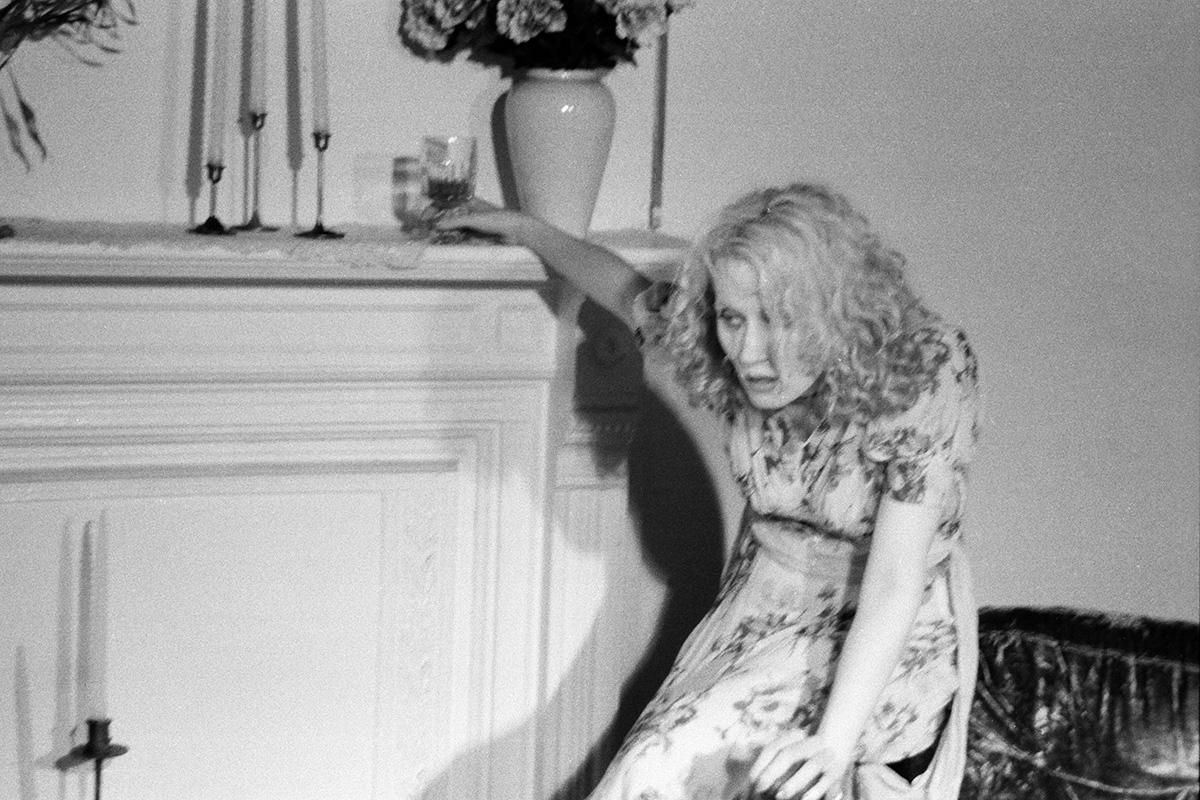
T.H.F.: Well, Hitchcock was a man making those films of women, and I’m a woman making films, so in one sense it’s really quite simple. I’m aware that theoretically it’s complicated but, you know, it never occurred to me to really make films that had dominant male characters in them. Ultimately, they’re about a female experience or a female journey or female identification of some kind. For example, when I made Dirty (1992) with Annabel Lee, we decided to replace the male gaze with the female gaze and just focus on the very first part of the Bataille book Blue of Noon. So, you could say that in manipulating the narrative to support and express the female milieu or gaze, I’m doing the opposite to what Hitchcock did by removing the male as a driving element.
R.G: One of the things I wanted to mention is the sound in your films, which ranges from the soundtrack to The Thief of Baghdad (1940) to Philip Glass to Manorexia, although you’ve more recently started working with Mark Abramson. Could you talk a little bit about the sound in your films and how that developed?
T.H.F.: I mostly use music. Very occasionally I mix in a sound effect or some ambient sound that I’ve recorded elsewhere. I’m not opposed to using sound in a sort of choppy way, in the way that I use the choppiness for sound in the film Play Boy—one sound stops and the other just starts. The music in this film, Play Boy was a live accompaniment to the film The Thief of Baghdad, and the other piece of music was by Herbie Hancock. I like the intros to music. I like to play with it as it corresponds to the image—or it may not—it doesn’t really matter because it’ll do what it does. Just as the interplay of images will do what they do. They have their own life. I worked with Abramson, who gave me a lot of music that I really like. There are very different tones for different pieces.
R.G.: The other thing I find really interesting is the way that you always create short films.
T.H.F.: Right, okay, six minutes. That’s enough, you know?
R.G.: Is that because you feel like you’ve exhausted what you want to do, or you’re thinking of the viewer’s experience, or envisioning that it could just be looped forever?
T.H.F.: It could be. When I’m working with my films, they kind of reach their natural end. Typically that’s between ten and twelve minutes. The longest film I made was Rhonda Goes to Hollywood (1985), which is twenty-five minutes and was about Rhonda’s fascination with Hollywood. But that’s not really intended to be sat and watched. It was made to be part of a gallery installation, so it was meant to be dipped into as part of that.
R.G.: Is there anything further that you want to say?
T.H.F.: I really want to emphasize that the whole process of working with found footage for me is a sort of a relief. It’s a way of playing. Sometimes I’ll play with musicians, sometimes I’ll play with someone else. It’s a creative process that’s really interactive, so there’s a constant flow. It’s very different from going out and shooting a film where you plan the shots and then you shoot it, replicating what you had in your mind. It really depends on the feedback of what I’m seeing in front of me. It’s like this loop of spontaneous inspiration. I’ll see something and then I react to it or manipulate it or exaggerate it, so it’s an adventure.