
Finding the Found: Personality and precarity in San Francisco’s Other Cinema archive
Arriving at the door of 992 Valencia Street in San Francisco, the storefront of Artists’ Television Access (ATA), you encounter your first lesson in the subtle language of the Other Cinema (OC) archive. A piece of white paper is taped to the door, its handwritten message both imperative and cryptic: “Stomp LOUDLY!!!”
But where to stomp?
You scan the ground, seeking guidance. The concrete sidewalk slab with its purple pieces of circular glass—vault lights you’ll learn later—catches your eye first. You take a step to the left and stomp tentatively, the impact jars your heel and you wonder: who’s going to hear that?
It will take time to learn the actual protocol: one needs to step to the right instead of the left to find the metal grate, an artifact from when 992 Valencia was a bakery and workers transported canvas bags of flour from street to basement through this very portal.
This metal grate’s evolution from bakery logistics to cinematic entry signal mirrors the broader transformative nature of alternative film archives like OC. Housed within ATA, an artist-run venue that has screened experimental media since the 1980s, OC exemplifies how alternative archives occupy spaces of creative adaptation and repurposing. While institutional archives prioritize preservation and restricted access, spaces like OC, as well as accomplices such as Albuquerque’s Basement Films, the Chicago Film Society, the Prelinger Archive, and others, have carved out a different path creating living repositories where preservation coexists with active creation, screening, and community engagement.
Yet these spaces exist in a state of perpetual tension, sustained by the very forces that make them precarious: the passionate individuals whose dedication makes them possible, but whose centrality raises questions about their long-term survival. This precarity is magnified by the archive’s location in San Francisco’s Mission District—a neighborhood where experimental arts spaces have been steadily vanishing amid tech-driven gentrification, making OC’s continued existence all the more remarkable as both cultural resistance and endangered species.
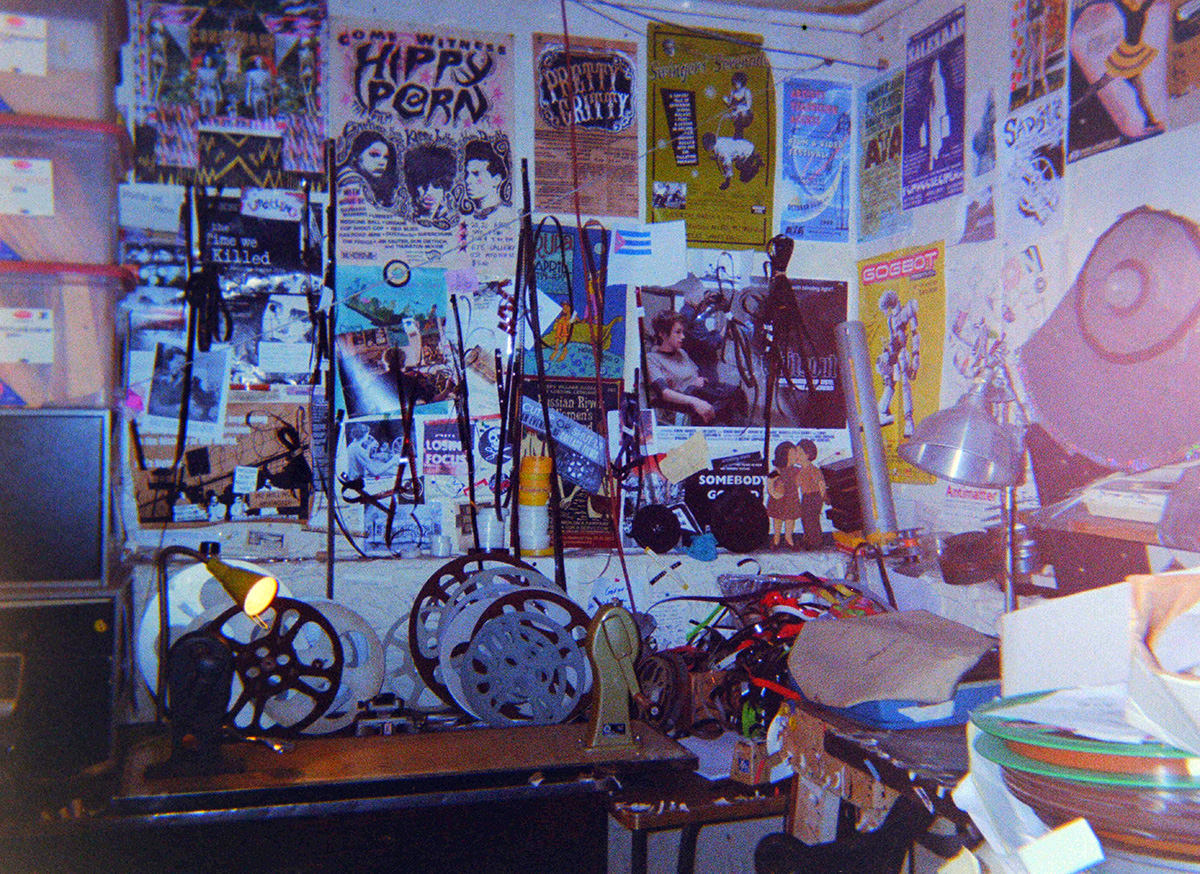
This tension manifests most visibly in the paradoxical relationship between individual vision and collective sustainability. While institutional archives often operate through systematic bureaucracy, cultural spaces like OC depend on the charismatic leadership and curatorial vision of singular figures—in this case, Craig Baldwin. This centrality of strong personalities creates both these archives’ distinctive character and their fundamental vulnerability. The passionate individuals who build these spaces become their gravitational centers, raising profound questions about succession and long-term viability that traditional archives, with their institutional structures, rarely face so acutely.
This personalized approach to archival practices manifests in both the physical organization and conceptual framework of these spaces. Unlike traditional archives that maintain strict boundaries between storage and exhibition, OC exemplifies what media theorist Wolfgang Ernst calls an anarchive—a space where conventional archival order gives way to dynamic and non-hierarchical relationships between objects and users. This apparent anarchic nature masks a deeper structure, one centered around the gravitational pull of its founder and curator. The OC archive reflects Baldwin’s improvisational mind, thoughtful observations, and bursts of creative energy. Small pockets of activity bustle in the various crafted zones—custom walled rooms for editing, curatorial work, archiving, viewing, and communicating. A box may fall with a crash-bang while you work but in his classic retort Baldwin will burst out “Don’t let that bother you! Don’t let that bother you!” And, in sync with the energy of the space, you won’t let it bother you.
The OC archive remains a hub of constant activity, a place where traveling artists can crash, undergraduate interns expose themselves to the workings of the local scene, and veterans of the Bay Area film community gather to discuss their latest viewing experiences or wax poetic about upcoming projects. These social interactions overlap in delightful clashes of generations, areas of study, and life experience. In the archive, we are all guests of the collection and at the whim of what the unpredictable structure of the environment might bring forward on any particular visit.
Beyond media exposure related to one’s specific projects, you might encounter another maker (from near or far) in discussion about a film or historical event that may inspire, process an unusual collage of bric-a-brac items scattered like Easter eggs throughout the basement, or witness another artist in the act of sourcing—perhaps screening found footage films about Jesus, the animals of the Sonoran Desert, or cognitive development in children. There is not a sterile, private zone, a silent screening room, or a clean white wall to be found.
This living nature of the OC archive is perhaps best captured in three works that take the space itself as their subject. Each illuminates a particular aspect of how OC sustains experimental film culture through radical archival practices that reject institutional neutrality in favor of active engagement with communities and creative processes.
In the archive, we are all guests of the collection and at the whim of what the unpredictable structure of the environment might bring forward on any particular visit
The space itself: Bryan Boyce’s Other Basement
In Other Basement (2015), filmmaker and photographer Bryan Boyce harnesses point cloud visualization technology converted into a 3D model to document the space in a three-dimensional rendering, transforming fixed objects into fluid forms. We start our journey floating above three Victorian buildings before descending through those purple sidewalk vault lights into a realm where conventional physics seem suspended. Pulled along the thin hallway crowded by amorphous shapes rendered through point-cloud capture, a method of digital scanning that creates a three-dimensional image made of countless data points, we pass stacks of miscellany, posters, rickety projectors, a small tripod screen, and milk crates full of books and papers all glowing from within. All the while, visible in the distance hovers the honorous archive cast in a nuclear green, stacks upon stacks of found 16mm films rising like stalagmites. Here we come to rest in Baldwin’s 30-plus-year collection of found footage films, discarded objects recast with value by virtue of being collected, organized, and presented to the user for excision. Before us, one single film in a metal can floats zombie-like from the bunch and comes to hover center screen, fading to black and then to the eminent OC logo of a full solar eclipse.
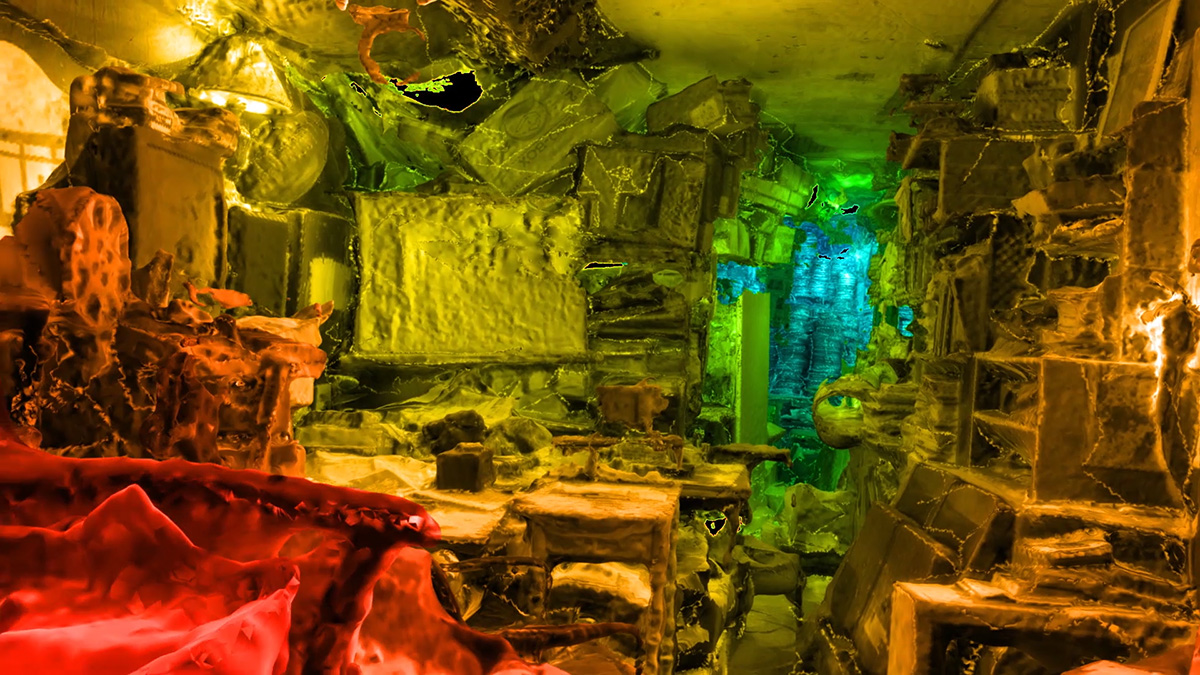
Other Basement’s pathway reveals the archive’s essential architecture: the ritual descent below street level, where one leaves the bustling Mission neighborhood behind (but never too far; you can still hear the rattle of shoes on the metal sidewalk plates). Then the passing through the archive’s central hall, lined by various cave-like rooms with directed purpose, any of which might detain a passing artist with a planned or unplanned task. The oozing point-cloud objects and the film’s otherworldly pulsing soundtrack point to the otherness of this space: it is no surprise ideas pounce upon an artist here, but in witnessing the precarious shapes and detritus, one does have to wonder how something like this can sustain itself without the tireless maintenance of one particular curator.
Significantly, Boyce’s piece is the only one of the three works examined in this text that doesn’t center the archive’s curator, Baldwin. In fact, there aren’t any human figures present in Boyce’s work. Instead, its focus is on the space’s materiality and organization, highlighting how the physical environment itself shapes creative practice. The point cloud approach brings together thousands of discrete data points to form coherent shapes, mirroring how the archive functions as a gathering point for disparate energies and objects. That Boyce chose to create the piece using point clouds is most fitting. What emerges from this scan is an aggregation of the thousands of small articles in the archive: a symbolic coming together of the energies of objects, medias, people, and architecture into a singular kind of syntropy. The color scheme—a near iridescent radioactive glow reminiscent of heat-mapping—indicates an internal energy to the forms within the space, suggesting how the archive pulses with latent creative potential.
Personal archive: Linda Scobie’s Craig’s Cutting Room Floor
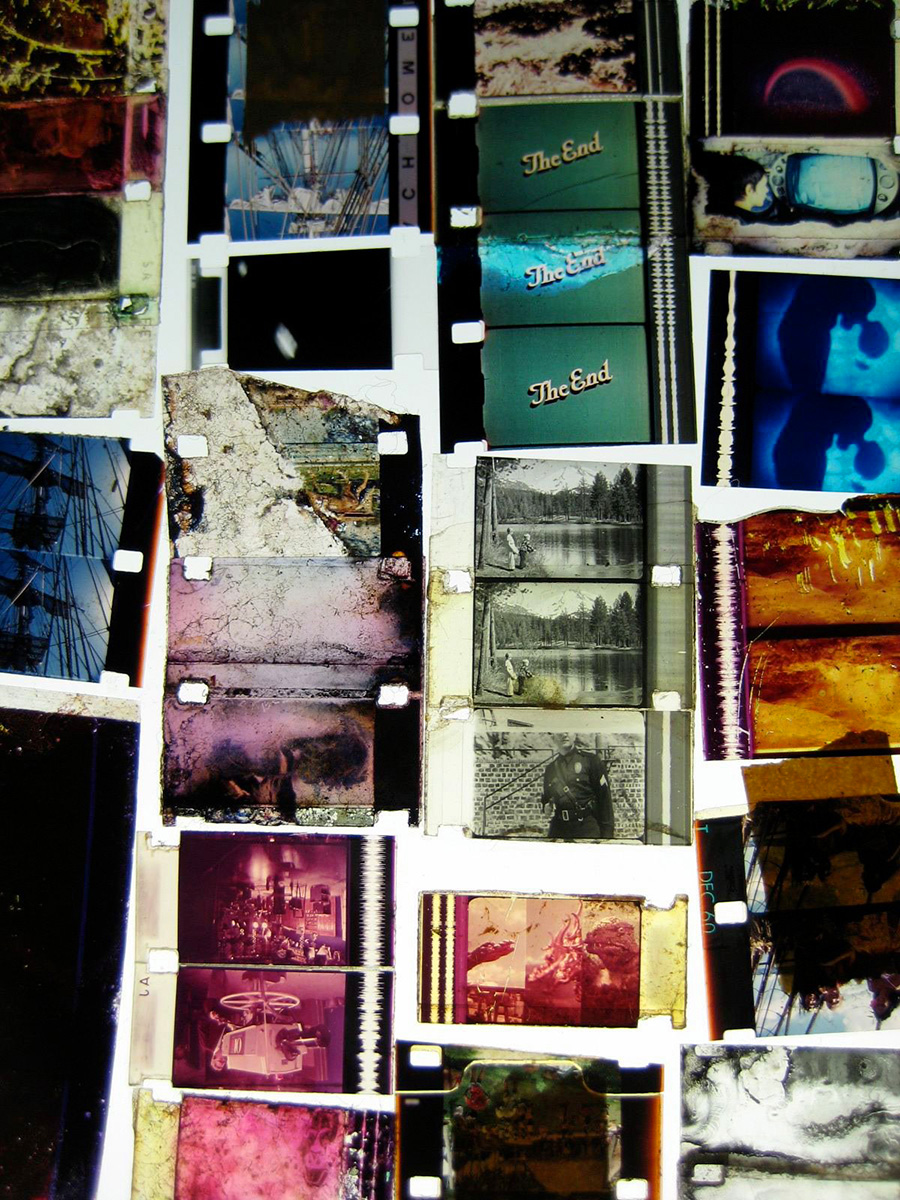
Linda Scobie’s Craig’s Cutting Room Floor (2011) embodies the interplay between individual stewardship and collective creation that characterizes spaces like OC. The title acknowledges the physical reality—these fragments were indeed collected from the OC basement editing station, from the actual floor where Baldwin and countless other artists come to construct works. In gathering these fragments, Scobie reveals how a single curator’s space becomes a repository for an entire community’s creative process.
Composed entirely of two-to-three-frame segments of found footage, the film is cleverly stitched together by Scobie with a presstape splicer, creating puzzle-shaped connections between fragments that mirror the nucleotides in DNA. As the celluloid speeds through the projector, images blend with persistence of vision. We spy countless brief moments (King Tut, a nuclear family, a blur of abstract color and texture) and hear a cacophony of clicks, beeps, and broken conversations. These minutiae are a particularly potent index of the archive, demonstrating the breadth of footage available for viewing and redefinition and how these pieces play against each other. Their discard reflects the structure of the creative process in the basement—the finality in the splicer blade, the artist making a commitment, the chaos of analog editing with squirrelly 16mm, and the castaway physical detritus that inevitably falls through cracks for yet another round of filmmakers to pick up and redefine.
Standing as an unusual combined workspace far removed from the sterile white-gloved archives of universities, libraries, and museums, this basement invites organic and accidental collaboration. With the ripples that each passing artist leaves upon the pool of footage found on the floor after their personal harvest, another layer of reused detritus crashes onto the basement’s shore. Complicating this interaction is the precarity of the space—existing on the margins, it is true that access presents itself only to those brave enough to descend into the mess. And, for some, this is just a place of harvest: filmmaking technology has moved well beyond the editing resources available within the basement. There is a dichotomy in Scobie’s piece: a film like this could only have risen from the chaos of this space, but the state of the basement also presents itself as somewhat of an existential threat, a liability, were it to be exposed to the wrong forces.
But, this unusual, fragile environment fosters a special kind of comradery and community that works in the archive’s favor to safeguard against the rapidly shifting world above. Similar to Baldwin’s own work in constructing both the archive and countless cohorts of makers as he waves each of us down the stairs and into the lair, Scobie composes a collective narrative out of discrete entities. This mode of creation suggests a strong, though undefined, sense of solidarity between fellow makers united beneath the ideological umbrella of the found.
Community memory: Jeremy Rourke’s You’re Not Listening
In Jeremy Rourke’s You’re Not Listening (2017), the filmmaker harnesses a combination of object pixilation, paper stop-motion animation, and live performance to document the Other Cinema archive. This special multi-media mode of capture demonstrates how this alternative archive breaks down boundaries between collection, venue, and community. Spinning in the partial darkness of the 16mm film stacks, we start by focusing on a bright green film can, the celluloid curling its way back into its plastic womb via stop-motion. As the can turns to expose its title, it is revealed that not only has Rourke harvested footage from the archive for this project, but Rourke’s You’re Not Listening is a repurposed title itself, sourced from the basement. Baldwin’s and Rourke’s voices in phone conversation join us on the soundtrack, immediately establishing the individual-collective dynamic that characterizes such spaces. As Rourke chats with Baldwin, the archive door swings open, ghost-like, and a 16mm projector journeys up the creaky staircase out onto the vibrant street. Baldwin’s voice pipes in behind the wandering projector: “Access is what I’m stressing, that is to say, to let people get to the archive and use it, and re-use it, and get the value out of it.”
Like in Boyce’s piece, the energy of the street follows us alongside the projector back down into the basement. As our guide descends the stairs, it turns into a paper miniature of itself, reflective of the duplicative meanings and reframed found imagery it is about to encounter down below. It glides over stacks of VHS and bumpy postered walls to several carefully placed paper notes pinned like fortunes above the editing station: “Chance favors the prepared mind” and “Life is won by wresting colors from the past.” This found word poem on the archive wall whets the mind of the pondering editor, pulling found footage on the 16mm rewinds just below. Rourke’s piece documents how the OC basement doesn’t just house films or found footage, but is made almost entirely with the found, from the furniture to the art on the walls. The use of ephemera in You’re Not Listening—stop-motion animation with paper and with objects from the archive, titles on the film cans, and more—speaks to the power and voice of the archive’s objects. Stripped of traditional commodified understanding and given new creative potential, this detritus is transformed into collaborative partners for every passing artist.
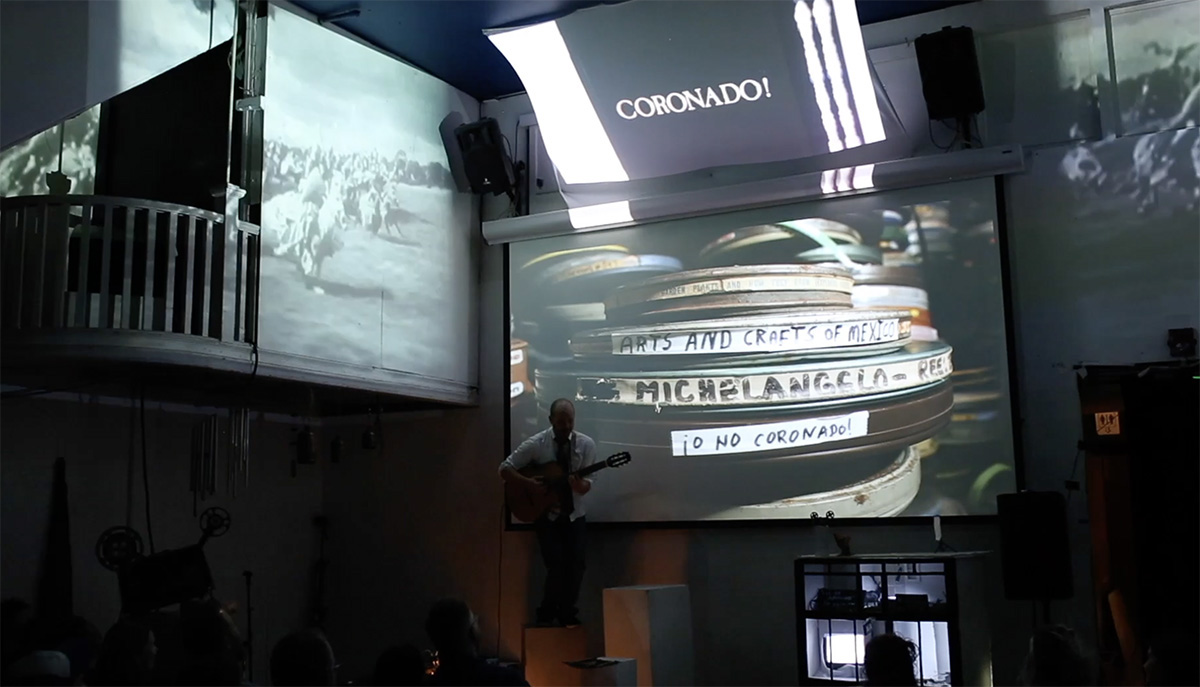
Back before the stalagmites of 16mm found footage, we return our gaze to the film cans, each sliding out to reveal titles such as End of the Old Order, My World…Water, We Live in a Trailer, and Spokane River. As they emerge, Rourke’s voice lyricizes the titles into a found song. An unseen audience laughs joyfully along with his live rendering. As Rourke continues to verse two, we travel upstairs to a live show at Other Cinema. Standing precariously atop a salvaged street podium, Rourke sings and strums surrounded by four projections of his animations from the OC archive and the found films themselves. The found song continues:
Garden Plants and How They Grow
Arts and Crafts of Mexico
Michelangelo,
O No Coronado!
And the audience cheers at the allusion to Baldwin’s O No Coronado! (1992) nestled among educational and industrial film titles.
In Rourke’s film, we witness how the archive lives through collective memory and shared experience, bridging the gap between archive and screening space. When watching these films at Artists’ Television Access, there is a constant awareness of the archive resting just beneath the audience’s feet. This mental umbilical cord between the two spaces links and informs the zeitgeist of films made in the archive—the OC audience hovers not far from the maker’s mind when spooling out 16mm down in the basement.
Close to a decade later, watching Rourke’s piece is a somewhat sobering experience for those of us in daily contact with the archive. The bounty of Baldwin’s collection has visibly diminished, and the space has leaned closer to a mess of dysfunction than one of productivity. In the rapidly shifting national and local political climate, it is an undeniable reality that fewer and fewer spaces like these can still exist. At an early moment in You’re Not Listening, the phone connection between Rourke and Baldwin is briefly disrupted, at which point Jeremy poses to the silence: “Are you there?” In choosing to document the Other Cinema archive and Artists’ Television Access in this work, Rourke gently prods us not just to give thanks for the archive but to consider its functions and how community can sustain it.
The future of anarchival spaces
Alternative archives like OC invite us to explore essential questions about how experimental film culture sustains itself. These spaces operate through a delicate balance—they require passionate stewardship while fostering open access, they maintain necessary structures while encouraging anarchic creativity, and they center strong personalities while building collective memory. We visited Baldwin and shared our idea for this essay during his recent hospital stay, recovering from intensive radiation and chemotherapies. Baldwin himself posed perhaps the most crucial question facing such spaces, writing on a torn piece of printer paper and handing it over to us: “What happens to the OC archive after Craig Baldwin?”
This isn’t just a practical question about succession, but a broader inquiry into how alternative spaces navigate their inherent tensions. These spaces require the determined and stubborn vision of their founders and curators, but in order to last they need to be continually found by new layers of makers. In the archive, the mess expands and contracts, revealing to the passing artist an essential tidbit—a book oddly out of place with a relevant title, a scrap of paper pinned to the ceiling most unexpectedly, a stack of seemingly irrelevant found footage left behind by another artist’s digging—all of which can become resonantly recontextualized in a project in motion.
This isn’t just a practical question about succession, but a broader inquiry into how alternative spaces navigate their inherent tensions
Perhaps the future of these alternative archival spaces depends on their own recontextualization. Analogous to how 16mm films are cut, spliced, and resignified through assemblage with other media, the archives themselves can be appropriated and transformed through the emergent curation, participation, and programming of fellow film accomplices. If this is the case, then the future of the OC archive should perhaps not be seen through a linear prism suggesting that things continue exactly as Baldwin planned. Perhaps the spirit of the cut-up and detournement needs to be applied to the archive as a whole, opening up space for new archival practices to emerge, even if they generate anxieties about discontinuity with the past. Baldwin himself describes the archive as an environment of accident, so perhaps this basement archive’s future will be shaped by serendipity that pushes it in unique directions, with the hope that what remains continuous is its generation of wellsprings of projects and collaborations.
The future of such spaces may be uncertain given the high levels of precarity they’re surrounded by, but their role in nurturing experimental film culture through radical accessibility and creative engagement remains vital. The metal grate still stands ready at 992 Valencia Street, waiting for the next stomp that will signal another descent into this generative space. In the constant flow of people, materials, and ideas through this portal, we see how alternative archives don’t just store film history—they keep it alive through constant reactivation and reinterpretation, even as they grapple with the complex dynamics that make such spaces both essential and precarious.